menu   Home Answers Math Games Free Resources Contact Me  
Showing posts with label math. Show all posts

What is the real purpose of homework?


Dictionary.com defines homework as "schoolwork assigned to be done outside the classroom (distinguished from classwork)", but is homework beneficial? Teaching on the college level, I see many benefits to those students who have been required to complete real homework in high school. Here are just a few.

1) Homework can improve student achievement. Studies show that homework improves student achievement in terms of better grades, test results, and the likelihood of attending college.

2) Homework helps to reinforce learning and to develop good study habits and life skills. Homework assists students in developing key skills that they will use throughout their lives, such as accountability, self-sufficiency, discipline, time management, self-direction, critical thinking, and independent problem-solving. Homework assignments given to students actually help students prepare for getting a higher education degree. In fact, the more time a student spends honing his skills, the higher his chances are to enter the University of his dreams or later acquire the work he always wanted to do.

3) Homework can make students more responsible. Knowing that each homework assignment has a specific deadline that cannot be postponed makes students more responsible. It requires grit (perseverance), teaches them time management and causes them to prioritize their time for academic lessons.

As you read this list, I know there are many of you, especially those who have small children or teach younger children, who disagree. I am not here to argue about whether homework is appropriate in the lower grades, but I do want to advocate real homework on the high school level. When I say real homework here is what I mean.

In high school, students might finish their homework in the hall right before class and still earn a good grade; that just isn't possible in college. Homework may be due on a certain day, but it is acceptable if it is turned late. This typically doesn’t float on the college level. In high school, a student gets to the end of a semester and needs a few more points to pull up a grade because of missing or incomplete assignments; so, the student asks the teacher for extra credit work. Extra credit does not exist on the college level! You do the work you are given when you are given it!

I teach college freshmen, many who are woefully unprepared for the academic rigors and demands that are expected. For every one hour students take in college, they should expect two hours of outside work. In other words, if a student is taking 12 hours, they should expect to spend 24 hours on homework (12 x 2).  Of course this formula doesn't always work perfectly, but it is a good starting point. Usually, college freshmen are in disbelief that they are expected to spend so much time on work outside of class. In reality, they should expect to spend as much time on homework in college as they would at a job because college is a full time job!
Help, we're sinking!

When I hand out my syllabus, many of my freshmen are astonished when they discover the amount of homework I expect and require them to do (readings, papers, on-line research, projects, etc.)  AND to compound the problem, many instructors (including me) expect it to be done and handed in on time! Unfortunately, several students have to test the waters to find out that late papers are not accepted.

For those college students who've had little real homework in high school compounded by teachers who have allowed it to be turned in late, those students are aboard a sinking ship that is leaking fast! Sadly, those are the 2-3 students who fail my required class and have to retake it the next semester.

So, as you can see, the decision to agree with or disagree with assignments is really up to the student, but also they need to remember that the learning institution they attend has rules in place regarding assignments. And if homework is assigned, then it will need to be completed and handed in on time, or the impact on the final semester grade will certainly be negative.
-----------------------------------------------------------------------------

$1.80
Want a quicker and easier way to grade math homework? Try one of these two math rubrics. I still use them on the college level, and they save me a great deal of time!

In Math, what is the Difference Between Drill and Practice?


When I was a kid, one of the things I dreaded most was going to the dentist. Even though we were poor, my Mom took my brother and me every six months for a check-up.  Unfortunately, we didn’t have fluoridated water or toothpaste that enhanced our breath, made our teeth whiter, or prevented cavities.  I remember sitting in the waiting room hearing the drill buzzing, humming, and droning while the patient whined or moaned.  Needless to say, I did not find it a pleasant experience.

I am troubled that, as math teachers, we have carried over this idea of drill into the classroom. Math has become a “drill and kill” activity instead of a “drill and thrill” endeavor.  Because of timed tests or practicing math the same way over and over, many students whine and moan when it is math time.  So how can we get students to those “necessary” skills without continually resorting to monotonous drill?

First we must understand the difference between drill and practice.  In math drill refers to repetitive, non-problematic exercises which are designed to improve skills (memorizing basic math facts) or procedures the student already has acquired. It provides:

1)   Increased proficiency with one strategy to a predetermined level of mastery. To be important to learners, the skills built through drill must become the building blocks for more meaningful learning. Used in small doses, drill can be effective and valuable.

2)   A focus on a singular procedure executed the same way as opposed to understanding.  (i.e. lots of similar problems on many worksheets)  I have often wondered why some math teachers assign more than 15 homework problems.  For the student who understands the process, they only need 10-15 problems to demonstrate that.  For students who have no idea what they are doing, they get to practice incorrectly more than 15 times!

Unfortunately, drill also provides:

 3)  A false appearance of understanding.  Because a student can add 50 problems in one minute does not mean s/he understands the idea of grouping  sets.

 4)  A rule orientated view of math.  There is only one way to work a problem, and the reason why is not important!  (Just invert and multiply but never ask the reason why.)

5)   A fear, avoidance, and a general dislike of mathematics. A constant use of math drills often leaves students uninterested.

On the other hand, practice is a series of different problem-based tasks or experiences, learned over numerous class periods, each addressing the same basic ideas. (ex. different ways to multiply)  It provides:

1)   Increased opportunity to develop concepts and make connections to other mathematical ideas.  (i.e. A fraction is a decimal is a percent is a ratio.)

2)   A focus on providing and developing alternative strategies.  My philosophy, which hangs in my classroom, is: “It is better to solve one problem five ways than to solve five problems the same way.”  (George Polya)

3)   A variety of ways to review a math concept.  (ex. games, crosswords, puzzles, group work)

4)   A chance for all students to understand math and to ask why. (Why do we invert and multiply when dividing fractions?) 

5)   An opportunity for all students to participate and explain how they arrived at the answer. Some may draw a picture, others may rely on a number line, or a few may use manipulatives. Good practice provides feedback to the students, and explains ways to get the correct answer.

$5.00
Let’s look at it this way. A good baseball coach may have his players swing again and again in the batting cage. This drill will help, but by itself it will not make a strong baseball player whereas practicing hitting a ball with a pitcher requires reacting to the different pitches with thought, flexibility, and skill.
I am of the opinion that drill should not be omitted from the math classroom altogether.  Basic math skills should be automatic because being fluent in the basics makes advanced math easier to grasp.  There is a place for drill; however, its use should be kept to situations where the teacher is certain that is the most appropriate form of instruction.  Even though practice is essential, for math it isn't enough. If understanding doesn't come, practice and drill will only leave a student with disjointed skills. If we want to produce strong mathematicians, we must focus on the BIG conceptual ideas through practice in problem-based lessons. We must present ideas in as many forms as we can so that students will go beyond rote drill to insight.

If you are interested in sharing this with your staff, colleagues or parents, check out the EDITABLE power point entitled: Drill vs. Practice

Hands-On Math Using FREE Milk Lid Jug Lids


$3.00
Start saving milk jug lids because there are countless hands-on math activities you can do in your classroom using this free manipulative. Here are just four of those ideas.

1) Sort the lids by various attributes such as:
  • Color
  • Snap-on or Twist-on 
  • Label or No Label
  • Kind of edge (smooth or rough)
2) Let the students grab one handful of lids.
  • Ask the students to count the lids.
  • See if the students can write that number.
3) Make a pattern using two different colors of lids.
 
  • Identify the pattern using letters of the alphabet or numbers. The pattern above would be an A, A, B pattern or a 1, 1, 2 pattern.
  • Now ask the students to use more than two colors to make a pattern
  • Once more, have the students identify the pattern using alphabet letters or numbers.
4) Decide on a money value for each color of lid. (Example: Red lids are worth a nickel, blue lids are worth a dime, and white lids are worth a penny.) Put all of the lids into a bag and have the students draw out four lids. Have the students add up the total value of these four lids.
  • Use play money (coins) to have the students show the value of the lids. 
  • Have the students practice writing money as either a part of a dollar or as cents.
  • Another idea is to have the students find all the combinations of lids that would equal a nickel or a dime or a quarter.
The resource, Milk Lid Math, contains over 15 hand-on ideas with numerous activities listed under each idea. The activities may be used with a whole group, small groups or as center activities.

Making Butterflies from Recycled Materials - Earth Day Ideas

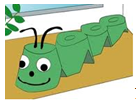
When one of my granddaughters was in kindergarten, she came home one day with egg carton caterpillars.  I know most of us have made one of these in our lifetime, but to her, this was the best craft ever!

She told me that her teacher was raising butterflies in her classroom, and soon the butterflies would hatch.  Anticipation and excitement reigned until the day she came out of school telling everyone that one of the butterflies had hatched.  However, much to her chagrin, the teacher was going to let it go.  My granddaughter just couldn't understand why or how her teacher could do that!

But, here is the good part!  She got to make a cocoon out of a toilet paper cylinder.  She covered it by gluing on white cotton balls.  Then she made a butterfly out of tissue paper and a small plastic bag tie.  She put the butterfly inside the cocoon and then pretended to have the butterfly hatch!  This was done over and over and over until the cocoon was no more.  Luckily, I was able to get pictures before both were literally destroyed!

Now, what does all of this have to do with math?  I contemplated all the ways to use recycled products to make items for the classroom.  Thus Trash to Treasure was created. It is full of art ideas, fun and engaging mini-lessons as well as cute and easy-to-construct crafts all made from recycled or common, everyday items.
Find out more than 14 ways to use milk lids for math. Did you know that you can practice math facts using clear plastic containers? Learn how to take two plastic plates and turn them into angle makers. How about using two plastic beverage lids to make card holders for kindergartners or for those whose hands are disabled? Discover ten ways to use carpet squares as well as nine ways to use old calendars. How about playing hop scotch on old carpet squares? Were you aware that butter tubs can become an indoor recess game to practice addition or multiplication facts? These are just a few of the fun and exciting activities that use recycled items found in this resource entitled Trash to Treasure.

Because these numerous activities vary in difficulty and complexity, they are appropriate for any PreK - 4th grade classroom, and the visual and/or kinesthetic learners will love them.

Linking Literature and Math Using the Book, "Math Curse." It's the Perfect Book for the Beginning of the Year!

I love books that link math and literature, and one of my favorites is Math Curse by Jon Scieszka. Published in 1995 through Viking Press, the book tells the story of a student who is cursed by the way mathematics works in everyday life. It is a tale where everything is a math problem, from tabulating teeth to calculating a bowl of corn flakes. Everything in life becomes a math problem.

First you see the math teacher, Mrs. Fibonacci, (don’t you love that name?) declare, “You know, you can think of almost everything as a math problem.” Then you watch as the student turns into a “raving math lunatic” since s/he believes “Mrs. Fibonacci has obviously put a math curse on me.”

From sunrise to sunset, the student anxiously mulls over the answers to countless calculations such as: How much time does it take to get ready and be at the bus stop? (a problem the reader can solve.). Estimate how many M M's you would eat if you had to measure the Mississippi River using M Ms. There is even an English word problem: “If mail + box = mailbox, does lipstick – stick = lip? Does tunafish + tunafish = fournafish?” (silly, but funny.) A class treat of cupcakes becomes a study in fractions, while a trip to the store turns into a problem of money. The story continues until the student is finally free of the math curse, but then again Mr. Newton, the science teacher, regrettably says, “You know, you can think of almost everything as a science experiment.”

Math Curse is full of honest to goodness math problems (and some rather unrelated bonus questions, such as "What does this inkblot look like?"). Readers can try to solve the problems and check their answers located on the back cover of the book. The problems are perfect to get students’ minds working and thinking about how math really does apply to their everyday life.

The illustrations by Lane Smith are one of a kind. They are busy and chaotic to reflect the “math zombie” this student becomes. Many resemble a cut and paste project, with some images touching or overlapping others. Mostly dark colors are used especially when the student begins to dream s/he is trapped in a blackboard room covered with never-ending math problems. (a nightmare for many) Smith’s art work makes Scieszka's words come to life and helps to paint a picture of what is going through the mind of the main character as s/he deals with the dreaded math curse.

John Scieszka does a remarkable job of breaking down the typical school day into math problems while also adding some tongue-in-cheek and light hearted humor which every mathphobic needs. The math is perhaps a little advanced for elementary students, but the problems are perfect for middle school or high school students.

Math Curse also demonstrates how a problem may seem difficult, but if you are persistent, you can find the solution to the problem. The book teaches not to fear or be anxious about math or for that matter, any other subject in school. Despite the fact the main character is completely overwhelmed by mathematics, it allows students who struggle with the identical feeling to know they are not alone. Any student who has ever been distressed over numbers, fractions, word problems and the like will certainly identify with the main character.

As a math teacher, I think this book makes math fun as well as interesting. Although I recognize math is everywhere in everyday life, I never realized just how much until I read the Math Curse and mathematically saw the day of a typical student. I believe what sets Math Curse apart from other books is that it accurately illustrates and explains how math is actually used and applied in day-to-day life. I love the story, the message, and especially the content.