

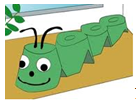
 When one of my granddaughters was in kindergarten, she came home one day with egg carton caterpillars. I know most of us have made one of these in our lifetime, but to her, this was the best craft ever!
She told me that her teacher was raising butterflies in her classroom, and soon the butterflies would hatch. Anticipation and excitement reigned until the day she came out of school telling everyone that one of the butterflies had hatched. However, much to her chagrin, the teacher was going to let it go. My granddaughter just couldn't understand why or how her teacher could do that!
 But, here is the good part! She got to make a cocoon out of a toilet paper cylinder. She covered it by gluing on white cotton balls. Then she made a butterfly out of tissue paper and a small plastic bag tie. She put the butterfly inside the cocoon and then pretended to have the butterfly hatch! This was done over and over and over until the cocoon was no more. Luckily, I was able to get pictures before both were literally destroyed!
Now, what does all of this have to do with math? I contemplated all the ways to use recycled products to make items for the classroom. Thus Trash to Treasure was created. It is full of art ideas, fun and engaging mini-lessons as well as cute and easy-to-construct crafts all made from recycled or common, everyday items.

Find out more than 14 ways to use milk lids for math. Did you know that you can practice math facts using clear plastic containers? Learn how to take two plastic plates and turn them into angle makers. How about using two plastic beverage lids to make card holders for kindergartners or for those whose hands are disabled? Discover ten ways to use carpet squares as well as nine ways to use old calendars. How about playing hop scotch on old carpet squares? Were you aware that butter tubs can become an indoor recess game to practice addition or multiplication facts? These are just a few of the fun and exciting activities that use recycled items found in this resource entitled Trash to Treasure.
Because these numerous activities vary in difficulty and complexity, they are appropriate for any PreK - 4th grade classroom, and the visual and/or kinesthetic learners will love them.
Because these numerous activities vary in difficulty and complexity, they are appropriate for any PreK - 4th grade classroom, and the visual and/or kinesthetic learners will love them.
