|
| I wish I understood this! |
I classify my students as mathphobics whose mathematical anxiety is hard to hide. One of my classes entitled, Fractions, Decimals and Percents, is geared for these undergraduates who have never grasped fractions. This article encompasses how I use a different method to teach adding fractions so these students can be successful. Specifically, let's look at adding fractions using the Cross Over Method.
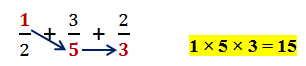
Below is a typical fraction addition problem. After writing the problem on the board, rewrite it with the common denominator of 6.
 Procedure:
1) Ask the students if they see any way to multiply and make a 3 using only the numbers in this problem.
2) Now ask if there is a way to multiply and make 2 using just the numbers in the problem.
3) Finally, ask them to find a way to multiply the numbers in the problem to make 6 the denominator.
4) Instruct the students to cross their arms. This is the cross of cross over and means we do this by cross multiplying in the problem.
5) Multiply the 3 and 1, then write the answer in the numerator. *Note: Always start with the right denominator or subtraction will not work.


 7) Now have the students uncross their arms and point to the right using their right hand. This is the over part of cross over. It means to multiply the two denominators and write the product as the new denominator.
8) Add the numerators only to find the correct answer.

9) Reduce to lowest terms when necessary.
Below is a typical fraction addition problem. After writing the problem on the board, rewrite it with the common denominator of 6.

1) Ask the students if they see any way to multiply and make a 3 using only the numbers in this problem.
2) Now ask if there is a way to multiply and make 2 using just the numbers in the problem.
3) Finally, ask them to find a way to multiply the numbers in the problem to make 6 the denominator.
4) Instruct the students to cross their arms. This is the cross of cross over and means we do this by cross multiplying in the problem.
5) Multiply the 3 and 1, then write the answer in the numerator. *Note: Always start with the right denominator or subtraction will not work.

6) Next multiply the 2 and 1 and write the answer in the numerator. Don’t forget to write the + sign. *Note: One line is drawn under both numbers. This is to prevent the students from adding the denominators (a very common mistake).

 7) Now have the students uncross their arms and point to the right using their right hand. This is the over part of cross over. It means to multiply the two denominators and write the product as the new denominator.
8) Add the numerators only to find the correct answer.

9) Reduce to lowest terms when necessary.
 |
| $4.75 |
It is important that students know the divisibility rules for 2, 3, 5, 6, 9 and 10. In this way, they can readily reduce any problem. In addition, it is extremely important that the students physically do the motions while they learn. This not only targets the kinesthetic learner but also gives the students something physical that makes the process easier to remember. The pictures or illustrations for each technique also benefit the visual/spatial learner. Of course, the auditory student listens and learns as you teach each method.
I have found these unconventional techniques are very effective for most of my students. If you find this strategy something you might want to use in your classroom, a resource on how to add, subtract, multiply, and divide fractions is available by clicking the link under the resource cover. A video lesson is included to help you.