menu   Home Answers Math Games Free Resources Contact Me  
Showing posts with label angles. Show all posts

I'm Pro-Tractor! Correctly Teaching and Using Protractors

Using a protractor is supposed to make measuring angles easy, but somehow some students still get the wrong answer when they measure. Here are a few teacher tips that might help.

1)  Make sure that each student has the SAME protractor.  (To avoid having many sizes and types, I purchase a classroom set in the fall when they are on sale.)  If each student's protractor is the same, you can teach using the overhead or an Elmo, and everyone can follow along without someone raising their hand to declare that their protractor doesn't look like that!  (Since the protractor is clear it works perfectly on the overhead. No special overhead protractor is necessary.)

2) Show how the protractor represents 1/2 of a circle.  When two are placed together with the holes aligned, they actually form a circle.

3) Talk about the two scales on the protractor, how they are different, and where they are located.  It's important that the students realize that when measuring to start at zero degrees and not at the bottom of the tool.  They need to understand that the bottom is actually a ruler. 


I use a couple of word abbreviations to help my students remember which scale to use.

4)  When the base ray of an angle is pointing to the right, I tell the students to remember RB which stands for Right Below.  This means they will use the bottom scale to measure. 

5) When the base ray of an angle is pointing to the left, I tell the students to remember LT which are the beginning and ending letters of LefT. This means they will use the top scale to measure the angle.

6) Of course the protractor has to be on the correct side.  It's amazing how many students try to measure when the protractor is backwards.  All the information is in reverse!

7)  Make sure the students line up the hole with the vertex point of the angle, aligning the line on the protractor that extends from the hole, with the base ray.  Even if they choose the correct scale, if the protractor is misaligned, the answer will be wrong.

8)  Realize that the tools the students use are massed produced, and to expect students to measure to the nearest degree is impossible.  To purchase accurate tools such as engineer uses would cost more than any of us are willing to spend!

-----------------------------------------------------------------------------
$2.85
$3.50

If you would like supplementary materials for angles, check out these two products: Angles: Hands On Activities  or  Geometry Vocabulary Crossword Puzzle.

It Depends on the Angle - How to Distinguish between Complimentary and Supplementary Angles

My Basic Algebra Concepts class always does a brief chapter on geometry...my favorite to teach! We usually spend time working on angles and their definitions. My students always have difficulty distinguishing complimentary from supplementary angles. Since most of my students are visual learners, I had to come up with something that would help them to distinguish between the two.

The definition states that complementary angles are any two angles whose sum is 90°. (The angles do not have to be next to each other to be complementary.) As seen in the diagram on the left, a 30° angle + a 60° angle = 90° so they are complementary angles. Notice that the two angles form a right angle or 1/4 of a circle.

If I write the word complementary and change the first letter "C" into the number nine and I think of the letter "O" as the number zero, I have a memory trick my mathematical brain can remember.


Supplementary Angles are two angles whose sum is 180°. Again, the two angles do not have to be together to be supplementary, just so long as the total is 180 degrees. In the illustration on your right, a 110° angle + a 70° angle = 180°; so, they are supplementary angles. Together, they form a straight angle or 1/2 of a circle.

If I write the word supplementary and alter the "S" so it looks like an 8, I can mentally imagine 180°.


Since there are so many puns for geometric terms. I have to share a bit of geometry humor. (My students endure many geometry jokes!)


You might be interested in a variety of hands-on ideas on how to introduce angles to your students. Check out Having Fun With Angles.  It explains how to construct different kinds of angles (acute, obtuse, right, straight) using items such as coffee filters, plastic plates, and your fingers. Each item or manipulative is inexpensive, easy to make, and simple for students to use. All of the activities are hands-on and work well for kinesthetic, logical, spatial, and/or visual learners.

Does Such a Thing as a Left Angle Exist?

Geometry is probably my favorite part of math to teach because it is so visual; plus the subject lends itself to doing many hands-on activities, even with my college students.  When our unit on points, lines and angles is finished, it is time for the unit test.  Almost every year I ask the following question:  What is a left angle?   Much to my chagrin, here are some of the responses I have received over the years NONE of which are true!

1)   A left angle is the opposite of a right angle.

2)  On a clock, 3:00 o'clock is a right angle, but 9:00 o'clock is a left angle.

3)  A left angle is when the base ray is pointing left instead of right.

    4)      A left angle is 1/2 of a straight angle, like when it is cut into two pieces, only it is the part on the left, not the part on the right.
5)      A left angle is 1/4 of a circle, but just certain parts. Here is what I mean.


Now you know why math teachers, at times, want to pull their hair out!  Just to set the record straight, in case any of my students are reading this, there is no such thing as a left angle!  No matter which way the base ray is pointing, any angle that contains 90is called a right angle.


$3.50
If you would like some different hands-on ways to teach angles, you might look at the resource entitled, Angles: Hands-on Activities.  This resource explains how to construct different kinds of angles (acute, obtuse, right, straight) using items such as coffee filters, plastic plates, and your fingers. Each item or manipulative is inexpensive, easy to make, and simple for students to use. All of the activities are hands-on and work well for kinesthetic, logical, spatial, and/or visual learners.


From A Different Angle - Creating Angles using every day items

Here is a riddle for you.  What did the little acorn say when he grew up?  Give up?  It's Gee-I'm-A-Tree or Ge-om-e-try. This is what my students are beginning to study.  I absolutely love teaching this part of math, and it is interesting how the students respond. Those that are visual, love it, but usually, those who do better with the abstract aren't so fond of it.

I have a beautiful, talented daughter who loves languages.  She is fluent in Spanish and loves to write, write, and write.  To my chagrin, she always struggled in math, especially in high school, until she got to Geometry.  Her math grade changed from a disappointing (let's just say she passed Algebra) to an A.  She thought Geometry was wonderful!!

I enjoy teaching Geometry because there are so many concrete ways to show the students what you mean. For instance, when introducing angles, (before using protractors) I use my fingers, coffee filters (when ironed, they make a perfect circle), interlocking plastic plates, the clock, etc. to demonstrate what the various angles look like. Here is an example of what I mean.

To introduce right angle, I have the students fold a coffee filter (which is ironed flat) into fourths, and we use that angle to locate right angles all around the room.  We discuss the importance of a right angle in architecture, and what would happen if a right angle didn’t exist. 
We then use an analog clock to discover what time represents a right angle. Right away, they respond with 3:00 or 9:00. Some will say 3:30, but when I display 3:30 on a Judy clock (comes in handy even on the college level), they see that the hour hand is not directly on the three which means it is not a 90 degree angle.
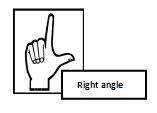
I also demonstrate a right angle by using my fingers.  What is great about fingers is that they are always with you.  I call the finger position you see on the right, Right on, Right angle.

$3.25
So are you ready for another geometry riddle?  (I have many!)  What is Orville and Wilbur's favorite angle? That’s right; it is a right (Wright) angle.

If you like geometry riddles, check out Geometry Parodies by clicking here. Also, if you are interested in many different concrete ways to teach angles, take a look at my product entitled: Angles: Geometry Hands-On Activities.