menu   Home Answers Math Games Free Resources Contact Me  
Showing posts with label geometry. Show all posts

Making Perfect Circles by Using Coffee Filters

When I teach angles or the properties of circles, I find that most children have difficulty cutting out a true circle (even with a blackline).  I have resorted to purchasing cheap coffee filters (not the cone shaped ones) and ironing them flat. You can iron several filters at one time, and once they are ironed, they form excellent ready-made circles. Here are some of the ways you can teach angles using these circles.
    Writing Formulas on the Coffee Filter Circle
  1. Introduce the fact that each and every circle contains 360 degrees.
  2. Have the students fold their coffee filter in half. Discuss that this is a straight angle. Ask, “How many degrees does it contain if it is one-half of a circle?” (180 degrees)
  3. Have the students fold the coffee filter one more time, into fourths. Talk about this angle being called a right angle and that it contains 90 degrees. Ask, "What fractional part of a circle is this?"
  4. Have the students use this fourth of a circle to locate places in the classroom where it will fit (e.g. the corner of their desk, a corner of a book, a corner of the board).
  5. Explain that these corners are right angles and without right angles, we would live in a crooked world. Nothing would be straight!
  6. With older students, have them write the parts of the circle and the formulas needed for solving problems about circles on the coffee filter circle.
Linking Math and Literature for Older Students

Read Sir Cumference and the First Round Table (A Math Adventure) by Cindy Neuschwander. This is a story about a clever knight of King Arthur’s named Sir Cumference. By using ideas offered by the knight’s wife, Lady Di of Ameter, and his son, Radius, King Arthur finds the perfect shape for his table. Basic geometric vocabulary involving circles (circumference, radius, and diameter) is introduced.
$3.50

Want more hands-on ideas for teaching angles? Check out Angles: Hands-On Geometry Activities.

You are invited to the Inlinkz link party!

Click here to enter

I'm Pro-Tractor! Correctly Teaching and Using Protractors

Using a protractor is supposed to make measuring angles easy, but somehow some students still get the wrong answer when they measure. Here are a few teacher tips that might help.

1)  Make sure that each student has the SAME protractor.  (To avoid having many sizes and types, I purchase a classroom set in the fall when they are on sale.)  If each student's protractor is the same, you can teach using the overhead or an Elmo, and everyone can follow along without someone raising their hand to declare that their protractor doesn't look like that!  (Since the protractor is clear it works perfectly on the overhead. No special overhead protractor is necessary.)

2) Show how the protractor represents 1/2 of a circle.  When two are placed together with the holes aligned, they actually form a circle.

3) Talk about the two scales on the protractor, how they are different, and where they are located.  It's important that the students realize that when measuring to start at zero degrees and not at the bottom of the tool.  They need to understand that the bottom is actually a ruler. 


I use a couple of word abbreviations to help my students remember which scale to use.

4)  When the base ray of an angle is pointing to the right, I tell the students to remember RB which stands for Right Below.  This means they will use the bottom scale to measure. 

5) When the base ray of an angle is pointing to the left, I tell the students to remember LT which are the beginning and ending letters of LefT. This means they will use the top scale to measure the angle.

6) Of course the protractor has to be on the correct side.  It's amazing how many students try to measure when the protractor is backwards.  All the information is in reverse!

7)  Make sure the students line up the hole with the vertex point of the angle, aligning the line on the protractor that extends from the hole, with the base ray.  Even if they choose the correct scale, if the protractor is misaligned, the answer will be wrong.

8)  Realize that the tools the students use are massed produced, and to expect students to measure to the nearest degree is impossible.  To purchase accurate tools such as engineer uses would cost more than any of us are willing to spend!

-----------------------------------------------------------------------------
$2.85
$3.50

If you would like supplementary materials for angles, check out these two products: Angles: Hands On Activities  or  Geometry Vocabulary Crossword Puzzle.

It Depends on the Angle - How to Distinguish between Complimentary and Supplementary Angles

My Basic Algebra Concepts class always does a brief chapter on geometry...my favorite to teach! We usually spend time working on angles and their definitions. My students always have difficulty distinguishing complimentary from supplementary angles. Since most of my students are visual learners, I had to come up with something that would help them to distinguish between the two.

The definition states that complementary angles are any two angles whose sum is 90°. (The angles do not have to be next to each other to be complementary.) As seen in the diagram on the left, a 30° angle + a 60° angle = 90° so they are complementary angles. Notice that the two angles form a right angle or 1/4 of a circle.

If I write the word complementary and change the first letter "C" into the number nine and I think of the letter "O" as the number zero, I have a memory trick my mathematical brain can remember.


Supplementary Angles are two angles whose sum is 180°. Again, the two angles do not have to be together to be supplementary, just so long as the total is 180 degrees. In the illustration on your right, a 110° angle + a 70° angle = 180°; so, they are supplementary angles. Together, they form a straight angle or 1/2 of a circle.

If I write the word supplementary and alter the "S" so it looks like an 8, I can mentally imagine 180°.


Since there are so many puns for geometric terms. I have to share a bit of geometry humor. (My students endure many geometry jokes!)


You might be interested in a variety of hands-on ideas on how to introduce angles to your students. Check out Having Fun With Angles.  It explains how to construct different kinds of angles (acute, obtuse, right, straight) using items such as coffee filters, plastic plates, and your fingers. Each item or manipulative is inexpensive, easy to make, and simple for students to use. All of the activities are hands-on and work well for kinesthetic, logical, spatial, and/or visual learners.

Does Such a Thing as a Left Angle Exist?

Geometry is probably my favorite part of math to teach because it is so visual; plus the subject lends itself to doing many hands-on activities, even with my college students.  When our unit on points, lines and angles is finished, it is time for the unit test.  Almost every year I ask the following question:  What is a left angle?   Much to my chagrin, here are some of the responses I have received over the years NONE of which are true!

1)   A left angle is the opposite of a right angle.

2)  On a clock, 3:00 o'clock is a right angle, but 9:00 o'clock is a left angle.

3)  A left angle is when the base ray is pointing left instead of right.

    4)      A left angle is 1/2 of a straight angle, like when it is cut into two pieces, only it is the part on the left, not the part on the right.
5)      A left angle is 1/4 of a circle, but just certain parts. Here is what I mean.


Now you know why math teachers, at times, want to pull their hair out!  Just to set the record straight, in case any of my students are reading this, there is no such thing as a left angle!  No matter which way the base ray is pointing, any angle that contains 90is called a right angle.


$3.50
If you would like some different hands-on ways to teach angles, you might look at the resource entitled, Angles: Hands-on Activities.  This resource explains how to construct different kinds of angles (acute, obtuse, right, straight) using items such as coffee filters, plastic plates, and your fingers. Each item or manipulative is inexpensive, easy to make, and simple for students to use. All of the activities are hands-on and work well for kinesthetic, logical, spatial, and/or visual learners.


Using Bloom's Taxonomy on a Geometry Test

As one of their assignments, my college students are required to create a practice test using pre-selected math vocabulary. This activity prompts them to review, look up definitions and apply the information to create ten good multiple choice questions while at the same time studying and assessing the material. Since I want the questions to be more than Level 1 (Remembering) or Level II (Understanding) of Bloom's Taxonomy, I give them the following handout to help them visualize the different levels.  My students find it to be simple, self explanatory, easy to understand and to the point.

Level I - Remembering


 What is this shape called?


Level II - Understanding


Circle the shape that is a triangle.


Level III - Applying

       Enclose this circle in a square.


Level IV - Analyzing

What specific shapes were used to draw the picture on your right?

Level V - Evaluating

How is the picture on your right like a real truck?  How is it  different?

Level VI - Creating

Create a new picture using five different geometric shapes. (You may use the same shape more than once, but you must use five different geometric shapes.)

As teachers, we are only limited by our imagination as to the activities we ask our students to complete to help them prepare for a test. However, we still need to teach and provide information so the students can complete these types of tasks successfully. With the aid of the above chart, my students create well written practice tests using a variety of levels of Bloom's. When the task is completed, my students have also reviewed and studied for their next math exam. I consider that as time well spent!

If you would like a copy of the above chart in a similar but more detailed format, it is available on Teachers Pay Teachers as a FREE resource.

Also available is a simple math dictionary. This 30 page math dictionary for students uses easy and clear definitions as well as formulas and examples so that students can learn and understand new math words without difficulty or cumbersome language. Most definitions include diagrams and/or illustrations for the visual learner. Over 300 common math terms are organized alphabetically for quick reference.

Let's Go Fly A Kite - Using the Correct Geometry Term for Diamond!


This was a comment I received from a fourth grade teacher, "Would you believe on the state 4th grade math test this year, they would not accept "diamond" as an acceptable answer for a rhombus, but they did accept "kite"!!!!!  Can you believe this? Since when is kite a shape name? Crazy."

First of all, there are NO diamonds in mathematics, but believe it or not, a kite is a geometric shape! The figure on the right is a kite. In fact, since it has four sides, it is classified as a quadrilateral. It has two pairs of adjacent sides that are congruent (the same length). The dashes on the sides of the diagram show which side is equal to which side. The sides with one dash are equal to each other, and the sides with two dashes are equal to each other.

A kite has just one pair of equal angles. These congruent angles are a light orange on the illustration on the left. A kite also has one line of symmetry which is represented by the dotted line. (A line of symmetry is an imaginary line that divides a shape in half so that both sides are exactly the same. In other words, when you fold it in half, the sides match.) It is like a reflection in a mirror.

The diagonals of the kite are perpendicular because they meet and form four right angles. In other words, one of the diagonals bisects or cuts the other diagonal exactly in half. This is shown on the diagram on the right. The diagonals are green, and one of the right angles is represented by the small square where the diagonals intersect.
Clip Art by My
Cute Graphics

There you have it! Don't you think a geometric kite is very similar to the kites we use to fly as children? Well, maybe you didn't fly kites as a kid, but I do remember reading about Ben Franklin flying one! Anyway, as usual, the wind is blowing strong here in Kansas, 
so I think I will go fly that kite!

-----------------------------------------------------


$2.50
This set of two polygon crossword puzzles features 16 geometric shapes with an emphasis on quadrilaterals and triangles. The words showcased in both puzzles are: congruent, equilateral, isosceles, parallelogram, pentagon, polygon, quadrilateral, rectangle, rhombus, right, scalene, square, trapezoid and triangle.  The purpose of these puzzles is to have students practice, review, recognize and use correct geometric vocabulary. Answer keys are included.

You are invited to the Inlinkz link party!

Click here to enter

From A Different Angle - Creating Angles using every day items

Here is a riddle for you.  What did the little acorn say when he grew up?  Give up?  It's Gee-I'm-A-Tree or Ge-om-e-try. This is what my students are beginning to study.  I absolutely love teaching this part of math, and it is interesting how the students respond. Those that are visual, love it, but usually, those who do better with the abstract aren't so fond of it.

I have a beautiful, talented daughter who loves languages.  She is fluent in Spanish and loves to write, write, and write.  To my chagrin, she always struggled in math, especially in high school, until she got to Geometry.  Her math grade changed from a disappointing (let's just say she passed Algebra) to an A.  She thought Geometry was wonderful!!

I enjoy teaching Geometry because there are so many concrete ways to show the students what you mean. For instance, when introducing angles, (before using protractors) I use my fingers, coffee filters (when ironed, they make a perfect circle), interlocking plastic plates, the clock, etc. to demonstrate what the various angles look like. Here is an example of what I mean.

To introduce right angle, I have the students fold a coffee filter (which is ironed flat) into fourths, and we use that angle to locate right angles all around the room.  We discuss the importance of a right angle in architecture, and what would happen if a right angle didn’t exist. 
We then use an analog clock to discover what time represents a right angle. Right away, they respond with 3:00 or 9:00. Some will say 3:30, but when I display 3:30 on a Judy clock (comes in handy even on the college level), they see that the hour hand is not directly on the three which means it is not a 90 degree angle.
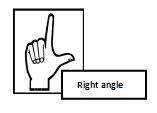
I also demonstrate a right angle by using my fingers.  What is great about fingers is that they are always with you.  I call the finger position you see on the right, Right on, Right angle.

$3.25
So are you ready for another geometry riddle?  (I have many!)  What is Orville and Wilbur's favorite angle? That’s right; it is a right (Wright) angle.

If you like geometry riddles, check out Geometry Parodies by clicking here. Also, if you are interested in many different concrete ways to teach angles, take a look at my product entitled: Angles: Geometry Hands-On Activities.


Aliens and Trapezoids

I am always looking for ways to help my students remember things.  For example, when we learn about the properties of one, I sing (yes I do, and a little off key) One is the Loneliest Number.  Since there are so many quadrilaterals to learn (*7 in all), I create quadrilateral stories.  Here is one of my students' favorites.  (Keep in mind, these are college students.)

Once upon a time, I planted a broccoli garden in my backyard.  Since I love geometry, I placed triangle statues all around my garden.  Every morning I would go out to my garden to weed, hoe, fertilize, and water my precious broccoli plants.  One morning, I noticed several of my plants had been eaten.  I was one upset lady; so, I decided to stay up all night and watch to see which critters had the nerve to venture into my garden for a broccoli feast.

That night, I sat at my bedroom window watching the garden.  All of a sudden, out of the sky, came a UFO which landed in my backyard.  As I watched, the door of the UFO opened (I use my arms to imitate the opening door while I say, S-q-e-a-k!) and out came some little aliens.  As they approached my broccoli, they repeated, "Zoid, zoid, zoid".  (I use a high alien like voice.) Sure enough, they ate several of my plants!  They then proceeded back to their spaceship and flew away. 

The same thing happened the following night and the night after that; so, I knew something had to be done.  I went to my garage, and got out my trusty chain saw to cut off the top of each of my triangles.  (I imitate the noise of a chain saw.)  Inside each cut off triangle I placed a bunch of broccoli to entice my visitors.  I knew if those aliens got inside, they would never get out because of the slanting sides.  I went back into my house to wait.

Sure enough, like clockwork, the UFO returned.  Again, the door of the UFO opened (s-q-e-a-k!) and out came the same little aliens. They proceeded to my cut off triangles, and perched on the edge peering down at the broccoli, all the while saying, "Zoid, zoid, zoid".  One by one they leaped inside to eat the broccoli, and guess what.  I trapped-a-zoid!  Okay, you may not be laughing, but I swear this story does help my students to remember what a trapezoid is. 

Let's discuss a couple of important math things about trapezoids that you may not be aware of.   In my story, the trapezoid is an isosceles trapezoid or as sometimes called, a regular trapezoid.  Not only does it have one set of opposite sides parallel, but it also has one set of opposite sides equal (marked with the black line segments).  It also has one line of symmetry which cuts the trapezoid in half (the blue dotted line).  This special trapezoid is usually the one taught by most teachers, but it is really a special kind of trapezoid. 

   trapezoid                                   isosceles trapezoid
For a quadrilateral to be classified as a trapezoid, the shape only needs to have one set of opposite sides parallel as seen in figure one.  The first trapezoid is the one that sometimes appears on tests to "trick" our students.

In the second figure (the isosceles or regular trapezoid), the sides that are not parallel are equal in length and both angles coming from a parallel side are equal (shown on the right).  Lucky for me that I used the second trapezoid for my trap or my zoids would have been long gone, and with my entire crop of broccoli, too!

*square, rectangle, rhombus, parallelogram, trapezoid, kite, trapezium

Faux Diamonds

In some preschool and kindergarten classes across the country, the geometric shape formerly known as a diamond is now being called a rhombus.  Why?  Does it matter? 

To be honest, a diamond is not technically a mathematical shape whereas a rhombus is.  When someone says the word rhombus, you know they are referring to a quadrilateral that has all four sides the same length; the opposite sides are parallel, and the opposite angles are equal.  (Mathematical Warning: A rhombus is not thinner than a diamond, AND the plural form, rhombi, is not a dance performed on the program Dancing With the Stars.)  

But what comes to mind when you hear the word diamond?  If you are a woman, you might envision a large sparkling gem setting on the ring finger of your left hand.  If you are a guy, you might think of a baseball infield. (The distance between each base is the same, making the shape a diamond.)  If you play cards, the word might bring to mind a suit of playing cards, OR you might recall a line in the song, Twinkle, Twinkle, Little Star.  Calling a rhombus a diamond is similar to calling a child a "kid" (could be a baby goat), or a home your "pad" (might be a notebook).  The first is an accurate term, the second one is not. 

So how does this affect you as a teacher?  It doesn't, unless rhombus is on a local benchmark or state test.  But if you are an elementary grade teacher, please use the correct mathematical language because a middle school math teacher will thank you; a high school geometry teacher will sing your praises, (see song below) and a college math teacher, like me, will absolutely love you for it!

Rhombus, Rhombus, Rhombus
  (sung to the "Conga" tune)
(The song where everyone is in a line with their hands on each other's shoulders)

 Rhombus, rhombus, rhombus;
Rhombus, rhombus, rhombus
Once it was diamond;
Now it's called a rhombus.

Are Trapezoids "Trapping" Your Students?

In a previous posting (Aliens and Trapezoids, July 7, 2011) I shared with you how I taught my students to remember the word trapezoid.  Today, I would like to talk about the characteristics of a trapezoid. 

As I search on Pinterest, I find quadrilaterals that look like the one on the right classified as "trapezoids".  Indeed they are, but this is a special kind of trapezoid because it has one set of equal sides, one line of symmetry and one set of parallel sides.  It is called an isosceles trapezoid.  Isosceles means "having two equal sides" just as an isosceles triangle has.
BUT to be a trapezoid, the only characteristic needed is one set of parallel sides.  Look at the red quadrilateral on the left.  It is a trapezoid because it has one set of parallel sides.  YET, students rarely see this kind except on those math tests that COUNT!  Why?  Because those trapezoids (and test writers) are out to "get" your students.  So think about it.  Are the trapezoids in your classroom trying to "trap" your students or can your students recognize a trapezoid even if it doesn't have symmetry? 


 --------------------------------------------------------------------------

I love teaching geometry, and therefore I have several geometry products for sale in my Teachers Pay Teachers Store.

Geometry Parodies - The four page handout includes 20 unusual definitions of geometric terms such as “A place where people are sent for committing crimes.” Each definition is a play on words or a parody.

Plane Geometry Test - This 100 point assessment is over
plain geometry concepts and focuses on using and applying geometry. Measuring and categorizing angles, identifying lines, angles, quadrilaterals, etc., solving for circumference, using formulas, recognizing symmetry, and comparing using and applying geometry. Measuring and categorizing angles, identifying lines, angles, quadrilaterals, etc., solving for circumference, using formulas, recognizing symmetry, and comparing two quadrilaterals are included.

Plane Geometry Vocabulary Crossword - This puzzle is designed so that the student will practice and use geometric vocabulary. It is a free form crossword puzzle that features 25 different geometry terms. The 25 clues are in the form of definitions which emphasize points, lines, and angles.

Solid Geometry Test - This 100 point test is a summative assessment given at the end of the solids unit in our math book. It highlights using and applying formulas to find area, perimeter, circumference, surface area, and volume.

Solid Geometry Vocabulary Crossword - This crossword puzzle is designed to practice geometric vocabulary and recognize formulas. It is a free form crossword puzzle that features 23 different geometric terms or formulas. The 23 clues are in the form of definitions or a formula format which give emphasis to polyhedrons, circles, and formulas for area, surface area, and volume.