menu   Home Answers Math Games Free Resources Contact Me  

Problem Solving With Number Tiles in Middle School

Math Activities for Grades 5-8
I prefer using hands-on activities when teaching math. One of the most successful items I have used is number tiles. Because number tiles can be moved around without the need to erase or cross out an answer, I have discovered that students are more at ease and more willing to try challenging activities. There is something about not having a permanent answer on the page that allows the student to explore, investigate, problem solve, and yes, even guess.

I have created several number tile booklets, but the one I will feature today is for grades 5-8. It is a booklet that contains 15 different math problem solving activities that range from addition and multiplication, to primes and composites, to exponent problems, to using the divisibility rules. Since the students do not write in the book, the pages can be copied and laminated so that they can be used from year to year. These activities may be placed at a table for math practice or as a center activity. They are also a perfect resource for those students who finish an assignment or test early. Use these activities to reteach a concept to a small group as well as to introduce a new mathematical concept to the whole class.

Students solve the Number Tile Math Activities by arranging ten number tiles, numbered 0-9. Most of the number tile activities require that the students use each tile only once. The number tiles can be made from construction paper, cardboard, or square colored tiles that are purchased.  (How to make the number tiles as well as storage ideas is included in the handout.) Each problem is given on a single page, and each activity varies in difficulty which is suitable for any diverse classroom. Since the students have the freedom to move the tiles around, they are more engaged and more willing to try multiple methods to find the solution. Some of the problems will have just one solution while others have several solutions. These activities are very suitable for the visual and/or kinesthetic learner.

A free version for each of my number tile resources is also available in my TPT store.  While visiting my store, take time to check out these additional Number Tile activities.


It Depends on the Angle - How to Distinguish between Complimentary and Supplementary Angles

My Basic Algebra Concepts class always does a brief chapter on geometry...my favorite to teach! We usually spend time working on angles and their definitions. My students always have difficulty distinguishing complimentary from supplementary angles. Since most of my students are visual learners, I had to come up with something that would help them to distinguish between the two.

The definition states that complementary angles are any two angles whose sum is 90°. (The angles do not have to be next to each other to be complementary.) As seen in the diagram on the left, a 30° angle + a 60° angle = 90° so they are complementary angles. Notice that the two angles form a right angle or 1/4 of a circle.

If I write the word complementary and change the first letter "C" into the number nine and I think of the letter "O" as the number zero, I have a memory trick my mathematical brain can remember.


Supplementary Angles are two angles whose sum is 180°. Again, the two angles do not have to be together to be supplementary, just so long as the total is 180 degrees. In the illustration on your right, a 110° angle + a 70° angle = 180°; so, they are supplementary angles. Together, they form a straight angle or 1/2 of a circle.

If I write the word supplementary and alter the "S" so it looks like an 8, I can mentally imagine 180°.


Since there are so many puns for geometric terms. I have to share a bit of geometry humor. (My students endure many geometry jokes!)


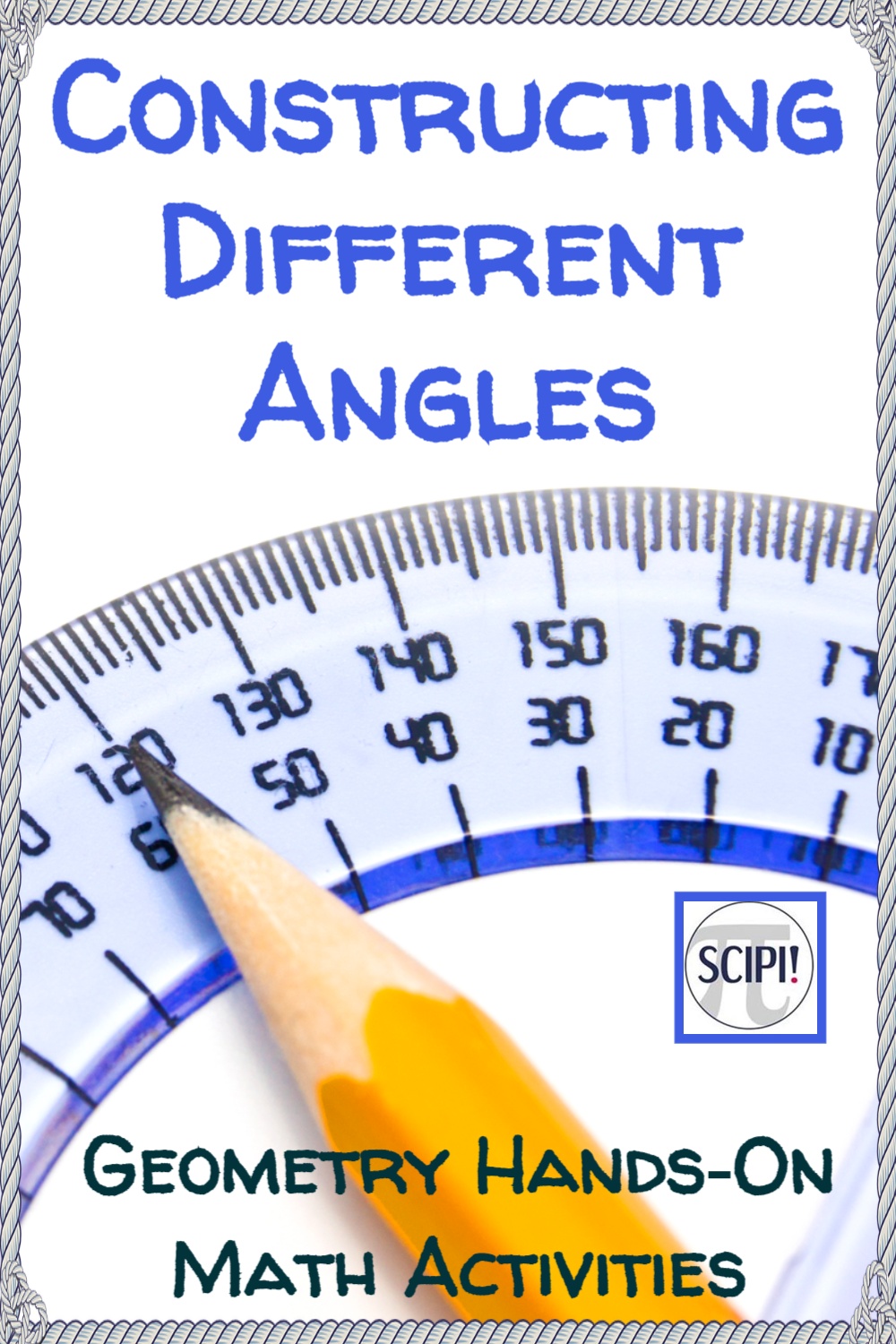
You might be interested in a variety of hands-on ideas on how to introduce angles to your students. Check out Having Fun With Angles.  It explains how to construct different kinds of angles (acute, obtuse, right, straight) using items such as coffee filters, plastic plates, and your fingers. Each item or manipulative is inexpensive, easy to make, and simple for students to use. All of the activities are hands-on and work well for kinesthetic, logical, spatial, and/or visual learners.

Does Such a Thing as a Left Angle Exist?

Geometry is probably my favorite part of math to teach because it is so visual; plus the subject lends itself to doing many hands-on activities, even with my college students.  When our unit on points, lines and angles is finished, it is time for the unit test.  Almost every year I ask the following question:  What is a left angle?   Much to my chagrin, here are some of the responses I have received over the years NONE of which are true!

1)   A left angle is the opposite of a right angle.

2)  On a clock, 3:00 o'clock is a right angle, but 9:00 o'clock is a left angle.

3)  A left angle is when the base ray is pointing left instead of right.

    4)      A left angle is 1/2 of a straight angle, like when it is cut into two pieces, only it is the part on the left, not the part on the right.
5)      A left angle is 1/4 of a circle, but just certain parts. Here is what I mean.


Now you know why math teachers, at times, want to pull their hair out!  Just to set the record straight, in case any of my students are reading this, there is no such thing as a left angle!  No matter which way the base ray is pointing, any angle that contains 90○ is called a right angle.


$3.50
If you would like some different hands-on ways to teach angles, you might look at the resource entitled, Angles: Hands-on Activities.  This resource explains how to construct different kinds of angles (acute, obtuse, right, straight) using items such as coffee filters, plastic plates, and your fingers. Each item or manipulative is inexpensive, easy to make, and simple for students to use. All of the activities are hands-on and work well for kinesthetic, logical, spatial, and/or visual learners.


Playing Math Games with older students

I currently teach remedial math students on the college level. These are the students who fail to pass the math placement test to enroll in College Algebra - that dreaded class that everyone must pass to graduate. The math curriculum at our community college starts with Basic Math, moves to Fractions, Decimals and Percents, and then to Basic Algebra Concepts. Most of my students are intelligent and want to learn, but they are deeply afraid of math. I refer to them as mathphobics.

We all have this type of student in our classrooms, whether it is middle school, high school, or college. When working with this type of student, it is important to bear in mind how all students learn. I always refer back to the Conceptual Development Model which states that a student must first learn at the concrete stage (use manipulatives) prior to moving to the pictorial stage, and in advance of the abstract level (the book). This means that lessons must include the use of different manipulatives. I use games a great deal because it is an easy way to introduce and use manipulatives without making the student feel like “a little kid.” I can also control the level of mathematical difficulty by varying the rules; thus, customizing the game to meet the instructional objectives my students are learning. However, as with any classroom activity, teachers should monitor and assess the effectiveness of the games.

When using games, other issues to think about are:

1) Excessive competition. The game is to be enjoyable, not a “fight to the death”.

2) Mastery of the mathematical concepts necessary for successful play. Mastery should be at an above average level unless teacher assistance is readily available when needed. A game should not be played if a concept has just been introduced.

3) Difficulty of the rules. If necessary, the rules should be modified or altered in order that the students will do well.

4) Physical requirements (students with special needs). These should be taken into account so that every player has an opportunity to win.

In addition to strengthening content knowledge, math games encourage students to develop such skills as staying on task, cooperating with others, and organization. Games also allow students to review mathematical concepts without the risk of being called “stupid”. Furthermore, students benefit from observing others solve and explain math problems using different strategies.

Games can also….
  1. Pique student interest and participation in math practice and review.
  2. Provide immediate feedback for the teacher. (i.e. Who is still having difficulty with a concept? Who needs verbal assurance? Why is a student continually getting the wrong answer?)
  3. Encourage and engage even the most reluctant student.
  4. Enhance opportunities to respond correctly.
  5. Reinforce or support a positive attitude or viewpoint of mathematics.
  6. Let students test new problem solving strategies without the fear of failing.
  7. Stimulate logical reasoning.
  8. Require critical thinking skills.
  9. Allow the student to use trial and error strategies.
Mathematical games give the learner numerous opportunities to reinforce current knowledge and to try out strategies or techniques without the worry of getting the “wrong” answer. Games provide students of any age with a non-threatening environment for seeing incorrect solutions, not as mistakes, but as steps towards finding the correct mathematical solution.
One math game my students truly enjoy playing is Bug Mania.  It provides motivation for the learner to practice addition, subtraction, and multiplication using positive and negative numbers. The games are simple to individualize since not every pair of students must use the same cubes or have the same objective. Since the goal for each game is determined by the instructor, the time required to play varies. It is always one that my students are anxious to play again and again!