menu   Home Answers Math Games Free Resources Contact Me  

Domino Math - Using Dominoes to Problem Solve and Practice Math Concepts

Dots Fun for Everyone
It is believed dominoes evolved from dice. In fact, the numbers in a standard double-six set of dominoes represent all the rolls of two six-sided die. It is thought they originated in China around the 12th century. They have been used in a large variety of games for hundreds of years, and today, dominoes are played all over the world.

Games allow children to learn a great deal concerning mathematical concepts and number relationships. Often, they are required to use critical thinking skills as well as varied math strategies to solve them. Since dominoes make a great manipulative for hands-on learning, I created a book of domino activities for grades 3-5 that are great for students who finish early or for introducing a new mathematical concept or for use at a math center. Using dominoes for a math practice center is a way to engage students while giving them a chance to review math facts.

The activities and three games vary in difficulty; so, differentiated instruction is easy. The variety of pages allows you to choose the practice page that is just right for each student. This resource correlates well with the CCSS standards.
Dots Fun

The activities in Dots Fun for Everyone (grades 3-5) include four digit place value, using the commutative property, problem solving, reducing proper and improper fractions and practicing multiplication and division facts. The games involve finding sums, using <, >, and = signs and ordering fractions.

These domino math activities in Dots Fun (primary grades) include recognizing sets, place value of two and four digit numbers, creating domino worms, gathering data, using the commutative property, and practicing addition and subtraction facts. The games involve matching, finding sums, and using greater than, less than, and equal signs. For these 13 activities and four games, you may use commercial sets dominoes or copy the blackline which is provided in the resource. This resource links closely with the CCSS standards. 

Some of the domino activities in these two resources use games while others will extend, enhance or introduce a new math concept. Since children are curious and inquisitive, plus some may have never seen dominoes, allow time for play and exploration before beginning any instruction. This is constructive as well as a productive use of class time. If they are not given this, most children will fool around and investigate during the teaching time.

To view examples from these resources as well as a complete Table of Contents, download the preview or FREE versions available at my TPT store.

You are invited to the Inlinkz link party!

Click here to enter

Even Today with Spell Check and Technology, Spelling is Important!

Noah Webster, an American lexicographer (one who compiles a dictionary) was the first person to write a dictionary of American English. It may have taken him more than 25 years to do so, but this book permanently altered the spelling of American English by offering a standardized way to spell and pronounce words. He learned 26 languages, including Anglo-Saxon and Sanskrit, in order to research the origins of our country's tongue. You may not know this, but Webster used the Bible as the foundation for his definitions.

Before his dictionary, Americans in different parts of the country spelled, pronounced and used words differently. To create uniformity, Noah used American spellings like "color" instead of the English "colour" and "music" instead " of "musick". He also added American words that didn't appear in English dictionaries like "skunk" and "squash". When he finished in 1828, Noah's dictionary contained 70,000 words.

During Webster's lifetime, American schools were anything but productive. Sometimes 70 children of all ages were crammed into one-room schoolhouses with no desks, poor books, and untrained teachers. The textbooks came from England. Noah thought Americans should learn from American books so he wrote a spelling book for children. Known for generations simply as The Blue-back Speller, millions of American children learned how to uniformly spell and pronounce words. Webster also established a system of rules to govern grammar, and reading. Clearly, he understood the power of words, their definitions, and the need for precise word usage in communication. Without a common oral and written language, he felt the country would remain divided.

Fast forward to today with the use of texting. Writing skills have turned into sentence fragments while spelling consists of numbers, symbols or abbreviations. These habits carry over when students are at school; consequently many really don’t know how to spell or write well. No longer can students punctuate correctly since text messages often contain run on sentences with no punctuation, In addition, with the constant use of lowercase letters, students fail to use capital letters where they should. How do I know? I teach at a community college where about 60% of our students are in remedial English which involves sentence structure, basic grammar and spelling. When assigning a written assignment, I must include how many words a good sentence contains and how many sentences are in an acceptable paragraph. Even these requirements do not guarantee a complete sentence.

It seems we have moved away from standard spelling to inventive spelling (an abbreviated, expedient form); yet customary spelling has not gone out of style. It is required at school, in business, at work and in just everyday life.  In addition, the correct spelling of words affects academic success. Students are frequently assessed on their skills in written language because it is considered a strong indication of their intelligence.

Spelling is an indication of a number of things when a person applies for a job.  When correct spelling is used, words are readable and communication is clear. This convinces a prospective employer that the job applicant has been well educated. It also tells them that they take care of detail and take pride in what they
present.  Let’s face it, university applications and job resumes littered with spelling errors don’t make it very far becuz badd spilleng is hrd two undrstnd wen yuu reed it.

Furthermore, good spelling streamlines communication. By following the identical rules for spelling words, we can all understand the text we read. Likewise, good spelling avoids confusion. In a way spelling is similar to football. It is up to the person passing the ball to make sure the receiver actually catches it. The same goes for spelling. If you write with intent and proper spelling, the receiver of that text will understand it.

As teachers and parents, we should care about the fundamental part good spelling plays in our language and everyday lives. We owe it to our students to give them the necessary skills and essential spelling tools for learning and communication so they can be successful.

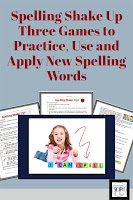
If you liked this article and would like to purchase some useful spelling resources, check out these two games. Their purpose is to help and encourage students to practice spelling words in a non-threatening way while having fun learning to spell.


You're Teaching Fractions All Wrong! Don't Flip When You Divide!


My college students in remedial math just finished the chapter on fractions. Talk about mathphobia. Dividing fractions was the most confusing for them because it requires finding the reciprocal of the second fraction, changing the division sign to a multiplication sign, and then multiplying the numerator times the numerator and the denominator times the denominator.

Let me introduce a new method entitled "Just Cross".

First and foremost, you must understand what division is. The statement 8 ÷ 4 means 8 divided into 4 equal sets, OR how many fours are in eight, OR how many times can we subtract 4 from 8? (Yes, division is repeated subtraction.)

Let me explain this using a hands-on visual. Let’s assume the fraction problem is:
The question being asked is, “How many ¼’s are in ½?” 
First, fold a piece of paper in half. The figure on the left represents ½. Next, fold the same sheet of paper in half again to make fourths as seen in the illustration on the right. When you unfold the paper, you will notice a total of four sections. So answering the original question: “How many ¼’s are in ½”, you can see that the half sheet of paper contains two parts; therefore:
Using the same example, to work the problem, the fraction 1/4 would have to be flipped to 4/1 nd then 1/2 would have to multiplied by 4/1 to get the correct answer of 2. That is why the division of fractions requires that the second fraction be inverted and the division sign be changed to a multiplication sign.

Let’s use the same fraction problem, but let’s utilize a different method entitled Just Cross. 
  • Cross your arms as a hands-on way of remembering the process.
  • Now multiply the denominator of 4 by 1 the denominator of 2 by1 as seen below. (We do nothing with the denominators.) Notice we always start on the right side and then we go to the left side. If it is done the opposite way, the answer will be incorrect. The answer of our first "cross" is the numerator (4 x 1); the answer to our second "cross" (2x1) is the denominator.
  • Now simply divide 4 by 2 to get the answer of 2.
No flipping; no reciprocal, no changing the division sign to a multiplication sign. Just Cross and divide. Amazingly, it works every time. 
-------------------------------------------------------------------------------
$4.75

Although fractions are something every student should learn, often times numerous students are left behind in the mathematical dust when a math textbook is followed page by page. I have a resource that features different ways to teach fractions using hands-on strategies similar to the one above. The unconventional techniques described in this math resource will always work.  Just go to Unlocking Fractions for the Confused and Bewildered.

Linking Literature and Math Using the Book, "Math Curse." It's the Perfect Book for the Beginning of the Year!

I love books that link math and literature, and one of my favorites is Math Curse by Jon Scieszka. Published in 1995 through Viking Press, the book tells the story of a student who is cursed by the way mathematics works in everyday life. It is a tale where everything is a math problem, from tabulating teeth to calculating a bowl of corn flakes. Everything in life becomes a math problem.

First you see the math teacher, Mrs. Fibonacci, (don’t you love that name?) declare, “You know, you can think of almost everything as a math problem.” Then you watch as the student turns into a “raving math lunatic” since s/he believes “Mrs. Fibonacci has obviously put a math curse on me.”

From sunrise to sunset, the student anxiously mulls over the answers to countless calculations such as: How much time does it take to get ready and be at the bus stop? (a problem the reader can solve.). Estimate how many M & M's you would eat if you had to measure the Mississippi River using M & Ms. There is even an English word problem: “If mail + box = mailbox, does lipstick – stick = lip? Does tunafish + tunafish = fournafish?” (silly, but funny.) A class treat of cupcakes becomes a study in fractions, while a trip to the store turns into a problem of money. The story continues until the student is finally free of the math curse, but then again Mr. Newton, the science teacher, regrettably says, “You know, you can think of almost everything as a science experiment.”

Math Curse is full of honest to goodness math problems (and some rather unrelated bonus questions, such as "What does this inkblot look like?"). Readers can try to solve the problems and check their answers located on the back cover of the book. The problems are perfect to get students’ minds working and thinking about how math really does apply to their everyday life.

The illustrations by Lane Smith are one of a kind. They are busy and chaotic to reflect the “math zombie” this student becomes. Many resemble a cut and paste project, with some images touching or overlapping others. Mostly dark colors are used especially when the student begins to dream s/he is trapped in a blackboard room covered with never-ending math problems. (a nightmare for many) Smith’s art work makes Scieszka's words come to life and helps to paint a picture of what is going through the mind of the main character as s/he deals with the dreaded math curse.

John Scieszka does a remarkable job of breaking down the typical school day into math problems while also adding some tongue-in-cheek and light hearted humor which every mathphobic needs. The math is perhaps a little advanced for elementary students, but the problems are perfect for middle school or high school students.

Math Curse also demonstrates how a problem may seem difficult, but if you are persistent, you can find the solution to the problem. The book teaches not to fear or be anxious about math or for that matter, any other subject in school. Despite the fact the main character is completely overwhelmed by mathematics, it allows students who struggle with the identical feeling to know they are not alone. Any student who has ever been distressed over numbers, fractions, word problems and the like will certainly identify with the main character.

As a math teacher, I think this book makes math fun as well as interesting. Although I recognize math is everywhere in everyday life, I never realized just how much until I read the Math Curse and mathematically saw the day of a typical student. I believe what sets Math Curse apart from other books is that it accurately illustrates and explains how math is actually used and applied in day-to-day life. I love the story, the message, and especially the content.