menu   Home Answers Math Games Free Resources Contact Me  

Is Extra Credit a Worthwhile Option?

Among teachers, extra credit work has its supporters and its critics, and there are a large number of "undecideds" as well. (Sounds like a political poll!) The range of viewpoints is understandable because the whats, when, whys and hows of extra-credit assignments really matter. Many instructors can't determine whether extra credit is a benefit or a liability, whether it is a point of contention or a headache. In other words, often it is a controversial practice.

When considering extra credit, think about these questions.

1) Does extra credit urge the students to spend less effort on their main assignments?

2) Are extra credit assignments meaningful or mere busy work?

3) Will extra credit encourage student behaviors that will not serve them well in the real world?

4) Should extra credit opportunities be extended to every student or be offered only to certain students on a case-by-case basis?

5) Can extra credit work contribute to grade inflation?

Teaching on the college level, I find that particular instructors never offer extra credit under any circumstances. (That’s me!) Others embrace it as a way to help students learn the course material or improve an unacceptable test score. A small minority, if pushed, will confess they only offer it when students wear them down until they finally give in to it. Most instructors understand that if there are too many opportunities for extra credit, it could possibly outweigh the required course assignments to the point where a student could pass the class without meeting all the standards. (YIKES!!)

I have always been anti-extra credit, the central reason being that it can inflate grades and allow students to receive grades that truly do not reflect their abilities or understanding of a subject. (Remember, I teach math.)  This is the way I view it.
  • Extra credit reinforces students’ beliefs that they don’t need to work hard because whatever they miss or choose not to do, they can make up with extra credit. 
  • Often, students who ask for extra credit tend to be those who aren’t succeeding or those who hope they won’t have to work hard because some easy extra credit opportunities will be available to them. 
  • It is an unintended chance to make up for low scores on earlier exams or missed assignments. (I would NEVER create extra credit assignments at the end of a grading period for students who needed a boost in their grades.) 
  • Time spent on extra credit means less time spent on regular assignments. 
  • Extra credit (especially if it is easy) lowers academic standards for everyone in the class. 
  • It is basically unfair to students who work hard and get it done the first time or turned in when it is due. 
  • Extra credit means more work for me in that it has to be graded! 
So after all of my rambling about extra credit work, my question to you is:

"What are your thoughts (pros and cons) about extra credit?" 
Leave a comment to participate in the discussion.


Reducing Fractions with Pattern Sticks!


When working with fractions, many of my students seem confident in performing the different operations, but a few are still unsure of how to reduce fractions. 

Although I have stressed learning the Divisibility Rules for 2, 5, 10, and the digital root for 3, 6, 9,  some still have difficulty since they do not know their multiplication tables. As a mathematics tool, I have the students make Pattern Sticks, a visual and kinesthetic aid, similar to a multiplication chart like the one on the left. Notice that an extra column (blue) has been added to the chart. (In this space, a hole is punched so that a 1" ring can be inserted to store all of the sticks in one place.)

On the right are the directions for making the Pattern Sticks using a multiplication chart. 

(Side note: My students cut out individual Pattern Sticks which I prefer over cutting a multiplication chart apart.)

I then give the students fractions such as 9/36 to reduce. Using the Pattern Sticks, they search for a column where a 9 and a 36 are lined up in the same column. They easily find it on the 1 strip and the 4 strip. They then take the two strips and line them up so that the 9 is over the 36. (see illustration above) By moving to the left, they discover that 9/36 is the same as 1/4. This is 9/36 in its lowest terms. Also notice that all the fractions in the illustration are equivalent fractions - fractions that have the same value. The Pattern Sticks can also be used to determine what number to divide by and to change improper fractions to mixed numbers.
$3.00

If you are interested in learning more about Pattern Sticks and how to use them in your classroom, check out the resource entitled Pattern Sticks: A Math Tool for Skip Counting & Reducing Fractions at Teachers Pay Teachers.


From A Different Angle - Creating Angles using every day items

Here is a riddle for you.  What did the little acorn say when he grew up?  Give up?  It's Gee-I'm-A-Tree or Ge-om-e-try. This is what my students are beginning to study.  I absolutely love teaching this part of math, and it is interesting how the students respond. Those that are visual, love it, but usually, those who do better with the abstract aren't so fond of it.

I have a beautiful, talented daughter who loves languages.  She is fluent in Spanish and loves to write, write, and write.  To my chagrin, she always struggled in math, especially in high school, until she got to Geometry.  Her math grade changed from a disappointing (let's just say she passed Algebra) to an A.  She thought Geometry was wonderful!!

I enjoy teaching Geometry because there are so many concrete ways to show the students what you mean. For instance, when introducing angles, (before using protractors) I use my fingers, coffee filters (when ironed, they make a perfect circle), interlocking plastic plates, the clock, etc. to demonstrate what the various angles look like. Here is an example of what I mean.

To introduce right angle, I have the students fold a coffee filter (which is ironed flat) into fourths, and we use that angle to locate right angles all around the room.  We discuss the importance of a right angle in architecture, and what would happen if a right angle didn’t exist. 
We then use an analog clock to discover what time represents a right angle. Right away, they respond with 3:00 or 9:00. Some will say 3:30, but when I display 3:30 on a Judy clock (comes in handy even on the college level), they see that the hour hand is not directly on the three which means it is not a 90 degree angle.
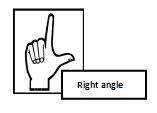
I also demonstrate a right angle by using my fingers.  What is great about fingers is that they are always with you.  I call the finger position you see on the right, Right on, Right angle.

$3.25
So are you ready for another geometry riddle?  (I have many!)  What is Orville and Wilbur's favorite angle? That’s right; it is a right (Wright) angle.

If you like geometry riddles, check out Geometry Parodies by clicking here. Also, if you are interested in many different concrete ways to teach angles, take a look at my product entitled: Angles: Geometry Hands-On Activities.


You Are An Important "Piece" of the Puzzle - using puzzles as ice breakers


I have quite a large family, 21 of us when we all get together. This past Christmas, my daughter insisted that I have name place cards so everyone would know where to sit. Since I thought this was a good idea, I went to the Dollar Tree and bought a 24 piece puzzle. I had my husband spray paint the pieces, and then, using a paint pen, I wrote each person's name on an individual piece. Since I had three pieces left over, I wrote "2017" on one, "Christmas" on another and drew a happy face on the third one. I then put a piece at each person's place at the table and explained that the theme for our dinner was "You are an important piece of our family."

When the 12 grandchildren finished eating Christmas dinner (they always finish first) they put the puzzle together. They were challenged but had fun doing it. They were also occupied while the adults finished eating.

This idea got me thinking about my college students. The first of the semester is always hard because they don't know me or one another, They are even unsure as where to sit. I got to thinking that this would be a great way to introduce my students to one another, and it would provide an interesting hands-on activity for the first day of class.

This might also be something that you could use at the beginning of the school year, but what happens if a student leaves or a new student is assigned to your room? If you paint both sides of the puzzle pieces, you can flip over the piece of the student who leaves and have a blank puzzle piece in its place. You can also leave blank ones to add new students. Don't forget, puzzles come in a variety of different sizes; so, if you have more than 24 students, it shouldn't be a problem. Just make sure the pieces themselves are large enough for the students to easily handle.