menu   Home Answers Math Games Free Resources Contact Me  

In Algebra, Why is any number to the zero power equal to one?


Sometimes my college students like to ask me what seems to be a difficult question. (In reality, they want to play Stump the Teacher.)  I decided to find out what sort of answers other mathematicians give; so, I went to the Internet and typed in the infamous question, "Why is any number to the zero power one?"  It was no surprise to find numerous mathematically correct answers, most written in what I call "Mathteese" - the language of intelligent, often gifted math people, who have no idea how to explain their thinking to others.  I thought, "Wow!  Why is math always presented in such complicated ways?"  I don't have a response to that, but I do know how I introduce this topic to my students. 

Since all math, and Imean all math, is based on patterns and not opinions or random findings, let's start with the pattern you see on the right.  Notice in this sequence, the base number is always 3.  The exponent is the small number to the right and written above the base number, and it shows how many times the base number, in this case 3, is to be multiplied by itself. 

(Side note: Sometimes I refer to the exponent as the one giving the marching orders similar to a military commander. It tells the base number how many times it must multiply itself by itself. For those students who still seem to be in a math fog and are in danger of making the grave error of multiplying the base number by the exponent, have them write down the base number as many times as the exponent says, and insert the multiplication sign (×) between the numbers. Since this is pretty straight forward, it usually works!) 

Notice our sequence starts with 31 which means 3 used one time; so, this equals three; 3means 3 × 3 = 9, 33 = 3 × 3 × 3 = 27, and so forth. As we move down the column, notice the base number of 3 remains constant, but the exponent increases by one. Therefore, we are multiplying the base number of three by three one additional time.

Now let's reverse this pattern and move up the column. How do we get from 243 to 81? That's right! We divide by three because division is the inverse operation (the opposite) of multiplication. How do we get from 243 to 81? That's right! We divide by three because division is the inverse operation (the opposite) of multiplication. Notice as we divide each time, the exponent by the base number of 3 is reduced by one. Let's continue to divide by three as we move up the column. 27÷ 3 = 9; 9 ÷ 3 = 3. Now we are at 3= 3 which means we must divide 3 by 3 which gives us the quotient of 1. Notice, to fit our pattern, the 3 in the left hand column would have to be 30; so, 3must equal one!

This works for any number you wish to put in the left hand column. Try substituting the base number of three with two. Work your way up the sequence dividing by two each time. You will discover that two divided by two equals one (20 = 1). Therefore, we can conclude that any natural number with an exponent of 0 is equal to one. (Zero is not included; it's another mystery to solve.)

What happens if we continue to divide up the column past 30 ?   (Refer back to the sequence on the left hand side.)  Based on the pattern, the exponent of zero will be one less than 0 which gives us the base number of 3 with a negative exponent of one or 3-1 .    To maintain the pattern on the right hand side, we must divide 1 by 3 which looks like what you see on the left. Continuing up the column and keeping with our pattern, 3 must now have a negative exponent of 2 or 3-2 and we must divide 1/3 by 3 which looks like what is written on the left.

Each time, the exponent by the base number of 3 is reduced by one. Let's continue to divide by three as we move up the column. 27÷ 3 = 9; 9 ÷ 3 = 3. Now we are at 31 = 3 which means we must divide 3 by 3 which gives us the quotient of 1. Notice, to fit our pattern, the 3 in the left hand column would have to be 30; so, 3must equal one! This works for any number you wish to put in the left hand column. Try substituting the base number of three with two. Work your way up the sequence dividing by two each time. You will discover that two divided by two equals one (20 = 1). Therefore, we can conclude that any natural number with an exponent of 0 is equal to one. (Zero is not included; it's another mystery to solve.)

As a result, the next two numbers in our pattern are..............??

Isn't it amazing how a pattern not only answers the question: "Why is any number to the zero power one?" But it also demonstrates why a negative exponent gives you a fraction as the answer. (By the way math detectives, do you see a pattern with the denominators?)
 
         Mystery Solved!   Case Closed!

This lesson is available on a video entitled:  Why Does "X" to the Power of 0 Equal 1?

----------------------------------------------------------------------------------------

$4.25

Want simple, visual answers to other difficult math questions? Try this resource entitled Six Challenging Math Questions with Illustrated Answers. Many of the answers feature a supplementary video for a more detailed explanation.

In Algebra, FOIL is NOT the Only Way to Multiply Polynomials.

Using FOIL
In more advanced math classes, many instructors happen to hate "FOIL" (including me) because it only provides confusion for the students. Unfortunately, FOIL (an acronym for first, outer, inner and last) tends to be taught as THE way to multiply all polynomials, which is certainly not true. As soon as either one of the polynomials has more than a "first" and "last" term in its parentheses, the students are puzzled as well as off course if they attempt to use FOIL. If students want to use FOIL, they need to be forewarned: You can ONLY use it for the specific case of multiplying two binomials. You can NOT use it at ANY other time!

When multiplying larger polynomials, most students switch
to vertical multiplication, because it is much easier to use, but there is another way. It is called the clam method. (An instructor at the college where I teach says that each set of arcs reminds her of a clam. She’s even named the clam Clarence; so, at our college, this is the Clarence the Clam method.)

Let’s say we have the following problem:

(x + 2) (2x + 3x – 4)

Simply multiply each term in the second parenthesis by the first term in the first parenthesis. Then multiply each term in the second parenthesis by the second term in the first parenthesis.

I have my students draw arcs as they multiply. Notice below that the arcs are drawn so they connect to one another to designate that this is a continuous process. Begin with the first term and times each term in the second parenthesis by that first term until each term has been multiplied.


When they are ready to work with the second term, I have the students use a different color.  This time they multiply each term in the second parenthesis by the second term in the first while drawing an arc below each term just as they did before.  The different colors help to distinguish which terms have been multiplied, and they serve as a check point to make sure no term has been missed in the process.

As they multiply, I have my students write the answers horizontally, lining up the like terms and placing them one under the other as seen below. This makes it so much easier for them to add the like terms:


This "clam" method works every time a student multiplies polynomials, no matter how many terms are involved.

Let me restate what I said at the start of this post: "FOIL" only works for the special case of a two-term polynomial multiplied by another two-term polynomial. It does NOT apply to in ANY other case; therefore, students should not depend on FOIL for general multiplication. In addition, they should never assume it will "work" for every multiplication of polynomials or even for most multiplications. If math students only know FOIL, they have not learned all they need to know, and this will cause them great difficulties and heartaches as they move up in math.

Personally, I have observed too many students who are greatly hindered in mathematics by an over reliance on the FOIL method. Often their instructors have been guilty of never teaching or introducing any other method other than FOIL for multiplying polynomials. Take the time to show your students how to multiply polynomials properly, avoid FOIL, if possible, and consider Clarence the Clam as one of the methods to teach. 


You are invited to the Inlinkz link party!

Click here to enter

A New Approach to the Order of Operations (PEMDAS)


Any math teacher who teaches the Order of Operations is familiar with the phrase, "Please Excuse My Dear Aunt Sally".  For the life of me, I don't know who Aunt Sally is or what she has done, but apparently we are to excuse her for the offense.  In my math classes, I use "Pale Elvis Meets Dracula After School".  Of course both of these examples are mnemonics or acronyms; so, the first letter of each word stands for something.  P = Parenthesis, E = Exponents, M = Multiplication, D = Division, A = Addition, and S = Subtraction

I have always taught the Order of Operations by just listing which procedures should be done first and in the order they were to be done.  But after viewing a different way on Pinterest, I have changed my approach. Here is a chart with the details and the steps to "success" listed on the right.

Since multiplication and division as well as addition and subtraction equally rank in order, they are written side by side. What I like about this chart is that it clearly indicates to the student what they are to do and when.  To sum it up:

When expressions have more than one operation, follow the rules for the Order of Operations:
  1. First do all operations that lie inside parentheses.
  2. Next, do any work with exponents or radicals.
  3. Working from left to right, do all the multiplication and division.
  4. Finally, working from left to right, do all the addition and subtraction.
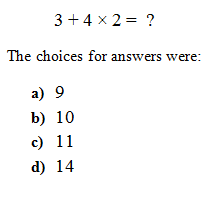
Failure to use the Order of Operations can result in a wrong answer to a problem.  This happened to me when I taught 3rd grade.  On the Test That Counts, the following problem was given.
The correct answer is 11 because you multiply the 4 x 2 and then add the 3, but can you guess which answer most of my students chose?  That's right - 14!  From that year on, the Order of Operations became a priority in my classroom.  Is it a priority in yours?  Should it be?

-------------------------------------------------------------------------------
$3.75

I have a product in my store entitled: Order of Operations - PEMDAS, A New Approach. This ten page resource includes a lesson plan outline for introducing PEMDAS, an easy to understand chart for the students, an explanation of PEMDAS for the student as well as ten practice problems. It is aligned with the fifth grade common core standard of 5.OA.1. Just click on the price under the cover page if it is something you might like.