menu   Home Answers Math Games Free Resources Contact Me  

Using Math Humor in Geometry

 I 've been using Pinterest (as well as Tailwind) for as long as I can remember, and I love it. Not only do I post many resources and teaching ideas there, but I learn so-o-o much. For example, I learned how to pack one suitcase with enough stuff for a week. (My husband is thrilled with this one.) I also learned that when you fry bacon, to make a small cup out of aluminum foil; pour the bacon grease into it; let the grease harden; then close up the aluminum cup and toss it into the trash. That is one I use all of the time!

On my Pinterest account I have a board entitled Humor - We Need It! I post many math cartoons or humorous sayings there. My favorite subject to teach my college remedial math students is geometry, and I have plenty of corny jokes that I intersperse into my lessons. Here's one.

What did the little acorn say when it grew up? Gee- I'm - A - Tree! (Geometry)

Or about this one?

What did the Pirate say when his parrot flew away? Polly-Gone (Polygon)

Here are some other geometry funnies from Pinterest.


Try placing a riddle or cartoon in the middle of a test.  I often do, and I know exactly where the students are by their laughs.  It helps them to relax and maybe get rid of those mathphobic tendencies.  I hope these math cartoons brought a smile to your face.  Have a great week of teaching!

$1.80
You might also like Geometry Parodies, a math handout that includes 20 unusual definitions of geometry terms. Each definition is a play on words or a parody. Twenty-six geometric terms that are possible answers are listed in a word bank, but not all of the words are used in the matching exercise. An answer key is included.

In Math, what is the Difference Between Drill and Practice?


When I was a kid, one of the things I dreaded most was going to the dentist. Even though we were poor, my Mom took my brother and me every six months for a check-up.  Unfortunately, we didn’t have fluoridated water or toothpaste that enhanced our breath, made our teeth whiter, or prevented cavities.  I remember sitting in the waiting room hearing the drill buzzing, humming, and droning while the patient whined or moaned.  Needless to say, I did not find it a pleasant experience.

I am troubled that, as math teachers, we have carried over this idea of drill into the classroom. Math has become a “drill and kill” activity instead of a “drill and thrill” endeavor.  Because of timed tests or practicing math the same way over and over, many students whine and moan when it is math time.  So how can we get students to those “necessary” skills without continually resorting to monotonous drill?

First we must understand the difference between drill and practice.  In math drill refers to repetitive, non-problematic exercises which are designed to improve skills (memorizing basic math facts) or procedures the student already has acquired. It provides:

1)   Increased proficiency with one strategy to a predetermined level of mastery. To be important to learners, the skills built through drill must become the building blocks for more meaningful learning. Used in small doses, drill can be effective and valuable.

2)   A focus on a singular procedure executed the same way as opposed to understanding.  (i.e. lots of similar problems on many worksheets)  I have often wondered why some math teachers assign more than 15 homework problems.  For the student who understands the process, they only need 10-15 problems to demonstrate that.  For students who have no idea what they are doing, they get to practice incorrectly more than 15 times!

Unfortunately, drill also provides:

 3)  A false appearance of understanding.  Because a student can add 50 problems in one minute does not mean s/he understands the idea of grouping  sets.

 4)  A rule orientated view of math.  There is only one way to work a problem, and the reason why is not important!  (Just invert and multiply but never ask the reason why.)

5)   A fear, avoidance, and a general dislike of mathematics. A constant use of math drills often leaves students uninterested.

On the other hand, practice is a series of different problem-based tasks or experiences, learned over numerous class periods, each addressing the same basic ideas. (ex. different ways to multiply)  It provides:

1)   Increased opportunity to develop concepts and make connections to other mathematical ideas.  (i.e. A fraction is a decimal is a percent is a ratio.)

2)   A focus on providing and developing alternative strategies.  My philosophy, which hangs in my classroom, is: “It is better to solve one problem five ways than to solve five problems the same way.”  (George Polya)

3)   A variety of ways to review a math concept.  (ex. games, crosswords, puzzles, group work)

4)   A chance for all students to understand math and to ask why. (Why do we invert and multiply when dividing fractions?) 

5)   An opportunity for all students to participate and explain how they arrived at the answer. Some may draw a picture, others may rely on a number line, or a few may use manipulatives. Good practice provides feedback to the students, and explains ways to get the correct answer.

$5.00
Let’s look at it this way. A good baseball coach may have his players swing again and again in the batting cage. This drill will help, but by itself it will not make a strong baseball player whereas practicing hitting a ball with a pitcher requires reacting to the different pitches with thought, flexibility, and skill.
I am of the opinion that drill should not be omitted from the math classroom altogether.  Basic math skills should be automatic because being fluent in the basics makes advanced math easier to grasp.  There is a place for drill; however, its use should be kept to situations where the teacher is certain that is the most appropriate form of instruction.  Even though practice is essential, for math it isn't enough. If understanding doesn't come, practice and drill will only leave a student with disjointed skills. If we want to produce strong mathematicians, we must focus on the BIG conceptual ideas through practice in problem-based lessons. We must present ideas in as many forms as we can so that students will go beyond rote drill to insight.

If you are interested in sharing this with your staff, colleagues or parents, check out the EDITABLE power point entitled: Drill vs. Practice

In Algebra, Why is any number to the zero power equal to one?


Sometimes my college students like to ask me what seems to be a difficult question. (In reality, they want to play Stump the Teacher.)  I decided to find out what sort of answers other mathematicians give; so, I went to the Internet and typed in the infamous question, "Why is any number to the zero power one?"  It was no surprise to find numerous mathematically correct answers, most written in what I call "Mathteese" - the language of intelligent, often gifted math people, who have no idea how to explain their thinking to others.  I thought, "Wow!  Why is math always presented in such complicated ways?"  I don't have a response to that, but I do know how I introduce this topic to my students. 

Since all math, and Imean all math, is based on patterns and not opinions or random findings, let's start with the pattern you see on the right.  Notice in this sequence, the base number is always 3.  The exponent is the small number to the right and written above the base number, and it shows how many times the base number, in this case 3, is to be multiplied by itself. 

(Side note: Sometimes I refer to the exponent as the one giving the marching orders similar to a military commander. It tells the base number how many times it must multiply itself by itself. For those students who still seem to be in a math fog and are in danger of making the grave error of multiplying the base number by the exponent, have them write down the base number as many times as the exponent says, and insert the multiplication sign (×) between the numbers. Since this is pretty straight forward, it usually works!) 

Notice our sequence starts with 31 which means 3 used one time; so, this equals three; 3means 3 × 3 = 9, 33 = 3 × 3 × 3 = 27, and so forth. As we move down the column, notice the base number of 3 remains constant, but the exponent increases by one. Therefore, we are multiplying the base number of three by three one additional time.

Now let's reverse this pattern and move up the column. How do we get from 243 to 81? That's right! We divide by three because division is the inverse operation (the opposite) of multiplication. How do we get from 243 to 81? That's right! We divide by three because division is the inverse operation (the opposite) of multiplication. Notice as we divide each time, the exponent by the base number of 3 is reduced by one. Let's continue to divide by three as we move up the column. 27÷ 3 = 9; 9 ÷ 3 = 3. Now we are at 3= 3 which means we must divide 3 by 3 which gives us the quotient of 1. Notice, to fit our pattern, the 3 in the left hand column would have to be 30; so, 3must equal one!

This works for any number you wish to put in the left hand column. Try substituting the base number of three with two. Work your way up the sequence dividing by two each time. You will discover that two divided by two equals one (20 = 1). Therefore, we can conclude that any natural number with an exponent of 0 is equal to one. (Zero is not included; it's another mystery to solve.)

What happens if we continue to divide up the column past 30 ?   (Refer back to the sequence on the left hand side.)  Based on the pattern, the exponent of zero will be one less than 0 which gives us the base number of 3 with a negative exponent of one or 3-1 .    To maintain the pattern on the right hand side, we must divide 1 by 3 which looks like what you see on the left. Continuing up the column and keeping with our pattern, 3 must now have a negative exponent of 2 or 3-2 and we must divide 1/3 by 3 which looks like what is written on the left.

Each time, the exponent by the base number of 3 is reduced by one. Let's continue to divide by three as we move up the column. 27÷ 3 = 9; 9 ÷ 3 = 3. Now we are at 31 = 3 which means we must divide 3 by 3 which gives us the quotient of 1. Notice, to fit our pattern, the 3 in the left hand column would have to be 30; so, 3must equal one! This works for any number you wish to put in the left hand column. Try substituting the base number of three with two. Work your way up the sequence dividing by two each time. You will discover that two divided by two equals one (20 = 1). Therefore, we can conclude that any natural number with an exponent of 0 is equal to one. (Zero is not included; it's another mystery to solve.)

As a result, the next two numbers in our pattern are..............??

Isn't it amazing how a pattern not only answers the question: "Why is any number to the zero power one?" But it also demonstrates why a negative exponent gives you a fraction as the answer. (By the way math detectives, do you see a pattern with the denominators?)
 
         Mystery Solved!   Case Closed!

This lesson is available on a video entitled:  Why Does "X" to the Power of 0 Equal 1?

----------------------------------------------------------------------------------------

$4.25

Want simple, visual answers to other difficult math questions? Try this resource entitled Six Challenging Math Questions with Illustrated Answers. Many of the answers feature a supplementary video for a more detailed explanation.

In Algebra, FOIL is NOT the Only Way to Multiply Polynomials.

Using FOIL
In more advanced math classes, many instructors happen to hate "FOIL" (including me) because it only provides confusion for the students. Unfortunately, FOIL (an acronym for first, outer, inner and last) tends to be taught as THE way to multiply all polynomials, which is certainly not true. As soon as either one of the polynomials has more than a "first" and "last" term in its parentheses, the students are puzzled as well as off course if they attempt to use FOIL. If students want to use FOIL, they need to be forewarned: You can ONLY use it for the specific case of multiplying two binomials. You can NOT use it at ANY other time!

When multiplying larger polynomials, most students switch
to vertical multiplication, because it is much easier to use, but there is another way. It is called the clam method. (An instructor at the college where I teach says that each set of arcs reminds her of a clam. She’s even named the clam Clarence; so, at our college, this is the Clarence the Clam method.)

Let’s say we have the following problem:

(x + 2) (2x + 3x – 4)

Simply multiply each term in the second parenthesis by the first term in the first parenthesis. Then multiply each term in the second parenthesis by the second term in the first parenthesis.

I have my students draw arcs as they multiply. Notice below that the arcs are drawn so they connect to one another to designate that this is a continuous process. Begin with the first term and times each term in the second parenthesis by that first term until each term has been multiplied.


When they are ready to work with the second term, I have the students use a different color.  This time they multiply each term in the second parenthesis by the second term in the first while drawing an arc below each term just as they did before.  The different colors help to distinguish which terms have been multiplied, and they serve as a check point to make sure no term has been missed in the process.

As they multiply, I have my students write the answers horizontally, lining up the like terms and placing them one under the other as seen below. This makes it so much easier for them to add the like terms:


This "clam" method works every time a student multiplies polynomials, no matter how many terms are involved.

Let me restate what I said at the start of this post: "FOIL" only works for the special case of a two-term polynomial multiplied by another two-term polynomial. It does NOT apply to in ANY other case; therefore, students should not depend on FOIL for general multiplication. In addition, they should never assume it will "work" for every multiplication of polynomials or even for most multiplications. If math students only know FOIL, they have not learned all they need to know, and this will cause them great difficulties and heartaches as they move up in math.

Personally, I have observed too many students who are greatly hindered in mathematics by an over reliance on the FOIL method. Often their instructors have been guilty of never teaching or introducing any other method other than FOIL for multiplying polynomials. Take the time to show your students how to multiply polynomials properly, avoid FOIL, if possible, and consider Clarence the Clam as one of the methods to teach. 


You are invited to the Inlinkz link party!

Click here to enter

A New Approach to the Order of Operations (PEMDAS)


Any math teacher who teaches the Order of Operations is familiar with the phrase, "Please Excuse My Dear Aunt Sally".  For the life of me, I don't know who Aunt Sally is or what she has done, but apparently we are to excuse her for the offense.  In my math classes, I use "Pale Elvis Meets Dracula After School".  Of course both of these examples are mnemonics or acronyms; so, the first letter of each word stands for something.  P = Parenthesis, E = Exponents, M = Multiplication, D = Division, A = Addition, and S = Subtraction

I have always taught the Order of Operations by just listing which procedures should be done first and in the order they were to be done.  But after viewing a different way on Pinterest, I have changed my approach. Here is a chart with the details and the steps to "success" listed on the right.

Since multiplication and division as well as addition and subtraction equally rank in order, they are written side by side. What I like about this chart is that it clearly indicates to the student what they are to do and when.  To sum it up:

When expressions have more than one operation, follow the rules for the Order of Operations:
  1. First do all operations that lie inside parentheses.
  2. Next, do any work with exponents or radicals.
  3. Working from left to right, do all the multiplication and division.
  4. Finally, working from left to right, do all the addition and subtraction.
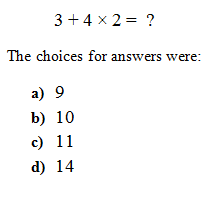
Failure to use the Order of Operations can result in a wrong answer to a problem.  This happened to me when I taught 3rd grade.  On the Test That Counts, the following problem was given.
The correct answer is 11 because you multiply the 4 x 2 and then add the 3, but can you guess which answer most of my students chose?  That's right - 14!  From that year on, the Order of Operations became a priority in my classroom.  Is it a priority in yours?  Should it be?

-------------------------------------------------------------------------------
$3.75

I have a product in my store entitled: Order of Operations - PEMDAS, A New Approach. This ten page resource includes a lesson plan outline for introducing PEMDAS, an easy to understand chart for the students, an explanation of PEMDAS for the student as well as ten practice problems. It is aligned with the fifth grade common core standard of 5.OA.1. Just click on the price under the cover page if it is something you might like.

Adding and Subtracting Positive and Negative Numbers Using a Hands-On Approach


When it comes to adding and subtracting positive and negative numbers, many students have great difficulty. In reality, it is a very confusing and abstract idea; so, it is important to give the students a concrete visual to assist them in seeing the solution. This idea is based on the Conceptual Development Model which is important to use when introducing new math concepts.  As a result, when teaching the concept of adding and subtracting positive and negative numbers, what would fall into each category?

When using the two-sided colored beans, the concrete stage of the Model would be where two-sided colored beans are used as an actual manipulative that can be moved around or manipulated by the students. There are a few rules to remember when using the beans.
  1. The RED beans represent negative numbers.
  2. The WHITE beans represent positive numbers. 
  3. One RED bean can eliminate one WHITE bean, and one WHITE bean can cancel out one RED bean. 
  4. All problems must be rewritten so that there is only one sign (+ or -) in front of each number.
Sample Problem

1) The student is given the problem - 5 + 2.

2) Since -5 is negative, the student gets out five red beans, and then two white beans because the 2 is positive.

3) Since some of the beans are red and two are white, the student must match one red bean with one white bean. (I tell my students that this is barbaric because the red beans eat the white beans. They love it!)

4) Because three red beans have no partner (they're left over) the answer to – 5 + 2 = - 3. (See example above.)

After mastering the concrete stage of the Conceptual Development Model, the students would move on to the pictorial stage. Sketching a picture of the beans would be considered pictorial. Have students draw circles to represent the beans, leaving the circles that denote positive numbers white and coloring the circles that represent negative numbers red.

As an example, let’s do the problem 3 - +5. First, rewrite the problem as 3 - 5. Now draw three white beans. Draw five more beans and color them red to represent -5. Match one white bean to one red bean. Two red beans are left over; therefore, the answer to 3 - +5 is -2.

3 - +5 = 3 – 5 = -2 

When students understand the pictorial stage, then abstract problems such as the ones in textbooks can be presented. (Notice, the textbook is the last place we go for an introduction.) I have found that most of my remedial college students move straight from the concrete stage (beans) to the abstract stage without any problem. Many put away the beans after two or three lessons. What works best for your students as they master this algebraic concept is something you will have to determine.

$5.40
If you would like a resource that gradually goes through these lessons, you can purchase it on Teachers Pay Teachers. It introduces the algebraic concept of adding and subtracting positive and negative numbers and contains several integrated hands-on activities. They include short math lessons with step-by-step instructions on how to use the beans, visual aids and illustrations, four separate and different practice student worksheets with complete answers in addition to detailed explanations for the instructor.

Factoring Polynomials Using a "Sure Fire" Method

I spent the summer months tutoring a high school girl who was getting ready to take Algebra II.  She didn't do very well in Algebra I and with geometry between the two classes, she was lost. Since she is a very concrete, visual person, I knew I needed to come up with different algebraic methods so she could succeed. 

When we got to to factoring trinomials, she really needed help as most of the methods were too abstract for her. For those of you who have forgotten, a trinomial is a polynomial that has three terms. Most likely, students start learning how to factor trinomials written in the form ax2 + bx + c

There are several different methods that can be used to factor trinomials.  The first is guess and check using ac and grouping. Find two numbers that ADD up to b and MULTIPLY to get ac in ax2 + bx + c. The second approach is the box method. You write the equation in a two-by-two box. This method is more thoroughly explained on You Tube. Look up factoring trinomials using the box method.  There is also the method of slide and divide which again you can look up on You Tube to see exactly how that works. Grouping is another method. Students need to choose which method they understand and which one works best for them. With continual practice, they will get better and faster at using it.

My favorite method is the one most students understand and grasp. It builds on the ac method, but takes it takes it one step further. It made sense to my student, and she was easily factoring trinomials after only two tutoring sessions.

Because it worked so well, I developed a new math resource. It is a step-by-step guide that teaches how to factor quadratic equations in a straightforward and uncomplicated way. It includes polynomials with common monomial factors, and trinomials with and without 1 as the leading coefficient. Some answers are prime. This simple method does not treat trinomials when a =1 differently since those problems are incorporated with “when a is greater than 1” problems.

Following each explanation (five total) are a set of six practice problems that replicate the method introduced. You might familiarize the students with the method, then assign the problems to practice, OR you might present all four explanations, and then assign the practice problems to review. Some students will catch on rapidly and will not need to go through all of the steps while others will need more repetition and practice. Differentiate your instruction accordingly. Try working in pairs or small groups since students tend to learn from each other.

-----------------------------------------------------------------------------

$5.25
Included in this resource are the following:
  • A detailed explanation of this factoring method.
  • Five variations when using this method
  • Five sets of practice problems – 30 in total
  • Two sets of review problems – 12 total
  • Answers Keys with the complete problem-solving process

Two Different Winter Crossword Puzzles Featuring 25 Words that Begin with "Snow"

I love winter. Yes, it's true. I love sweaters, a fire in the fireplace, throwing snowballs, eating snow ice cream and even the cold! As you can see from the photo, my grandchildren and I think snow is glorious.

Speaking of snow, have you ever wondered about snowflakes, how they are formed, how many different kinds there are? Here are a few fun facts about snowflakes that you might not have known.

  1.  The size of a snowflake depends on how many ice crystals connect together.
  2. Snowflakes form in a variety of different shapes.
  3. One of the determining factors in the shape of individual snowflakes is the air temperature around it.
  4. Snowflakes always have six sides.
  5. A single ice crystal is known as a snowflake.
  6. In total, 80 different shapes of snowflakes have been identified so far.
  7. Did you know that the saying that no two snowflakes are alike is actually a myth? It was true until 1988 when a scientist in Wisconsin managed to find two identical snowflakes.
I could go on and on, but since seven is the number of completion, I'll stop. 

$2.85
While researching snowflakes, I started wondering how many words I could find that began with the word "snow" as I  wanted to make a winter crossword puzzle. I found 25 although there were plenty more; I just didn't want to make the clues to my puzzle overwhelming. 

The title of this resource is Snowy Words. It includes two winter crossword puzzles; each with 25 words that all begin with “snow.” One crossword includes a word bank which makes it easier to solve while the more challenging one does not. Even though the same vocabulary is used for each crossword, each grid is laid out differently. Answers keys for both puzzles are included. 

Measuring Snow Using a Homemade Math Tool

I am not a very crafty person; so, I am always looking for items that are easy to make that I can give to my grandchildren. One year, I gave them a snowman making kit that included buttons, a carrot, six rocks and two sticks. This year, I am giving them a Snow Measuring Tool.  Not only was it fun to use, but it also helped them to practice using a ruler. Here is how you can make one!
 
Here is the list of supplies you will need:  

1) A paint stick - free at most paint stores
2) A permanent marking pen
3) Something to glue at the top of the stick (You can make it, or be like me and purchase one from a craft store.)

First, using a ruler, mark off every inch along the paint stick. I was able to make nine marks. (Notice I used the plain side of the paint stick and not the side with all of the advertising.) Now write the inches beside each corresponding mark.

When that is completed, glue the item you have chosen at the top of the stick.  I really wanted to use a snowflake, but my local craft store didn't have any; so, I settled on using one of Santa's reindeer.  Which one, I'm not sure since it didn't come with a name.(Hint: My husband used Gorilla Glue so the reindeer wouldn't fall off.)

When it snows, venture outside and stick the Snow Measuring Tool into the snow and read the number of inches that have fallen. If it isn't exactly on an inch mark, then have your child estimate using fractional parts.

While you are measuring the snow, think about this saying: "Ten inches of snow equals one inch of rain." I am sure you have heard that claim as it is a commonly shared belief that seems to be repeated every time it snows a few feet. But, is the saying true? The immediate answer is: Sometimes.

When the temperature is around 30 degrees, one inch of liquid precipitation (rain) would fall as 10 inches of snow, presuming the storm is all snow. But, the amount of moisture in each snowflake differs depending on the temperature which in turn changes the snow to rain ratio.

For example, if a big January snowstorm occurred with colder temperatures (such as 25 degrees), the snow ratio would be closer to 15 inches of snow to one inch of rain. In fact, weathermen take this into account when forecasting how much snow a location will receive. There have been storms with snow closer to 20 degrees, moving the snow ratio closer to 20 to one. And, when it's warmer, say 35-40 degrees, the ratio moves to 5" of snow to 1" of rain.

So, after your children measure the snow in your yard with their Snow Measuring Tool, try converting the inches of snow into inches of rain based on the 10":1" ratio. By doing so, you may become your neighborhood's weather forecaster or even better, a first rate mathematician!

Your children might enjoy this snowman glyph. It's is an excellent winter activity for reading and following directions, and requires problem solving, communication, and data organization.