menu   Home Answers Math Games Free Resources Contact Me  

How Will Your Students Celebrate Earth Day on April 22nd?

Earth Day began in 1970, when Gaylord Nelson, a U.S. Senator from Wisconsin, wanted nation-wide teaching on the environment. He brought the idea to state governors, mayors of big cities, editors of college newspapers, and to Scholastic Magazine, which was circulated in U.S. elementary and secondary schools.

Eventually, the idea of Earth Day spread to many people across the country and is now observed each year on April 22nd. The purpose of the day is to encourage awareness of and appreciation for the earth's environment. It is usually celebrated with outdoor shows, where individuals or groups perform acts of service to the earth. Typical ways of observing Earth Day include planting trees, picking up roadside trash, and conducting various programs for recycling and conservation.

Symbols used by people to describe Earth Day include: an image or drawing of planet earth, a tree, a flower or leaves depicting growth or the recycling symbol. Colors used for Earth Day include natural colors such as green, brown or blue.

The universal recycling symbol as seen above is internationally recognized and used to designate recyclable materials. It is composed of three mutually chasing arrows that form a Mobius strip which, in math, is an unending single-sided looped surface. (And you wondered how I would get math in this article!?!) This symbol is found on products like plastics, paper, metals and other materials that can be recycled. It is also seen, in a variety of styles, on recycling containers, at recycling centers, or anywhere there is an emphasis on the smart use of materials and products.

Inspired by Earth Day, Trash to Treasure is a FREE resource. In it, you will discover how to take old, discarded materials and make them into new, useful, inexpensive products or tools for your classroom. Because these numerous activities vary in difficulty and complexity, they are appropriate for any PreK-3 classroom, and the visual and/or kinesthetic learners will love them.

To download the free version, just click under the cover page on your left.

What Is the Fibonacci Number Sequence and Why Should I Care?

Fibonacci
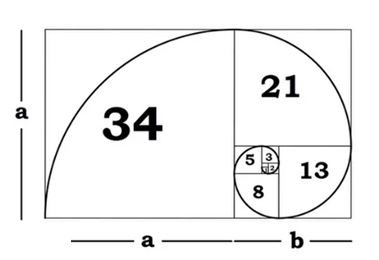
Even if you were taught about the Fibonacci number sequence in school, you probably don’t remember much about it. As with other higher levels of math, many aren’t sure how Fibonacci could possibly be relevant to their real lives; so, why should they even attempt to remember him or his sequence? In reality, Fibonacci numbers are something you come across practically every day. Even so, let’s go back and start at the beginning.

The Fibonacci number sequence is named after Leonardo of Pisa (1175-1240), who was known as Fibonacci. (I love to say that name because it sounds like I know a foreign language.) In mathematics, Fibonacci numbers are this sequence of numbers:
As you can see, it is a pattern, (all math is based on patterns). Can you figure out the number that follows 89? Okay, let's pretend I waited for at least 60 seconds before giving you the answer….144. By definition, the first two numbers in the Fibonacci sequence are 0 and 1, and each subsequent number is the sum of the previous two. For those who are still having difficulty, it is like this.


The next number is found by adding up the two numbers that precede it.
  • The 8 is found by adding the two numbers before it (3 + 5)
  • Similarly, 13 is found by adding the two numbers before it (5 + 8),
  • And the 21 is (8 + 13), and so on!
It is that simple! For those who just love patterns, here is a longer list:

 
Can you figure out the next few numbers?

The Fibonacci sequence can be written as a "Rule “which is: xn = xn-1 + xn-2 The terms are numbered from 0 forwards as seen in the chart below. xn is the term number n. xn-1 is the previous term (n-1) and xn-2 is the term before that (n-2)

Sometimes scientists and mathematicians enjoy studying patterns and relationships because they are interesting, but frequently it's because they help to solve practical problems. Number patterns are regularly studied in connection to the world we live in so we can better understand it. As mathematical connections are uncovered, math ideas are developed to help us be aware of the relationship between math and the natural world.
As I close, here are two questions to think about:

How might knowing this number pattern be useful?
What kinds of things can the numbers in the Fibonacci sequence represent?

Dominoes - An Inexpensive Manipulative to Use in Math

I am always looking for ordinary items that can be used in the classroom as manipulatives. I'm a firm believer in the Conceptual Development Model which advocates teaching the concrete (using manipulatives) prior to moving to the pictorial before even thinking about the abstract. When I was at the Dollar Tree (a great, inexpensive place to purchase school stuff) I saw sets of dominoes for $1.00 each. Since they were inexpensive and readily available, I decided to create several math activities and games to introduce, reinforce, or reteach math concepts.

The Number 52
Think about it; if you lay a domino horizontally, you have a two digit number. Put two dominoes side-by-side, and a four digit number is created. Now you can work with place value, estimation, or rounding.  How about lining up dominoes in a column, and working on addition (with or without regrouping) or subtraction (with or without renaming)? 

Another perfect domino activity is practicing addition or multiplication facts.  How about adding the two sides of the domino or multiplying the two sides together?

The Fraction 1/4
If a domino is placed vertically, you immediately have a fraction.  Placed one way it is a proper fraction, but rotated around, it is an improper fraction which can then be reduced.  A fraction can also be changed into a division problem, a ratio, a decimal, or a percent.

So think outside that box of dominoes and use them as an inexpensive math manipulative because Dots Lots of Fun!

Check out all my Domino Resources available on Teachers Pay Teachers.
The first two are absolutely FREE!
  1. Dots Fun for Everyone - FREE  Three math activities and one game for the intermediate grades.
  2. Dots Fun - FREE  Three math activities and one game for the primary grades.
  3. Dots Fun   A 24 page resource for grades 1-3 that includes 13 math activities and four games.
  4. Dots Fun for Everyone  A 29 page resource that features 15 math activities and three games for grades 3-6.
  5. Dots Lots of Fun  Seven math games that use dominoes for grades 2-5.