menu   Home Answers Math Games Free Resources Contact Me  
Showing posts with label math. Show all posts

Hands-On Math Using FREE Milk Lid Jug Lids


$3.00
Start saving milk jug lids because there are countless hands-on math activities you can do in your classroom using this free manipulative. Here are just four of those ideas.

1) Sort the lids by various attributes such as:
  • Color
  • Snap-on or Twist-on 
  • Label or No Label
  • Kind of edge (smooth or rough)
2) Let the students grab one handful of lids.
  • Ask the students to count the lids.
  • See if the students can write that number.
3) Make a pattern using two different colors of lids.
 
  • Identify the pattern using letters of the alphabet or numbers. The pattern above would be an A, A, B pattern or a 1, 1, 2 pattern.
  • Now ask the students to use more than two colors to make a pattern
  • Once more, have the students identify the pattern using alphabet letters or numbers.
4) Decide on a money value for each color of lid. (Example: Red lids are worth a nickel, blue lids are worth a dime, and white lids are worth a penny.) Put all of the lids into a bag and have the students draw out four lids. Have the students add up the total value of these four lids.
  • Use play money (coins) to have the students show the value of the lids. 
  • Have the students practice writing money as either a part of a dollar or as cents.
  • Another idea is to have the students find all the combinations of lids that would equal a nickel or a dime or a quarter.
The resource, Milk Lid Math, contains over 15 hand-on ideas with numerous activities listed under each idea. The activities may be used with a whole group, small groups or as center activities.

Making Butterflies from Recycled Materials - Earth Day Ideas

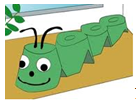
When one of my granddaughters was in kindergarten, she came home one day with egg carton caterpillars.  I know most of us have made one of these in our lifetime, but to her, this was the best craft ever!

She told me that her teacher was raising butterflies in her classroom, and soon the butterflies would hatch.  Anticipation and excitement reigned until the day she came out of school telling everyone that one of the butterflies had hatched.  However, much to her chagrin, the teacher was going to let it go.  My granddaughter just couldn't understand why or how her teacher could do that!

But, here is the good part!  She got to make a cocoon out of a toilet paper cylinder.  She covered it by gluing on white cotton balls.  Then she made a butterfly out of tissue paper and a small plastic bag tie.  She put the butterfly inside the cocoon and then pretended to have the butterfly hatch!  This was done over and over and over until the cocoon was no more.  Luckily, I was able to get pictures before both were literally destroyed!

Now, what does all of this have to do with math?  I contemplated all the ways to use recycled products to make items for the classroom.  Thus Trash to Treasure was created. It is full of art ideas, fun and engaging mini-lessons as well as cute and easy-to-construct crafts all made from recycled or common, everyday items.
Find out more than 14 ways to use milk lids for math. Did you know that you can practice math facts using clear plastic containers? Learn how to take two plastic plates and turn them into angle makers. How about using two plastic beverage lids to make card holders for kindergartners or for those whose hands are disabled? Discover ten ways to use carpet squares as well as nine ways to use old calendars. How about playing hop scotch on old carpet squares? Were you aware that butter tubs can become an indoor recess game to practice addition or multiplication facts? These are just a few of the fun and exciting activities that use recycled items found in this resource entitled Trash to Treasure.

Because these numerous activities vary in difficulty and complexity, they are appropriate for any PreK - 4th grade classroom, and the visual and/or kinesthetic learners will love them.

Linking Literature and Math Using the Book, "Math Curse." It's the Perfect Book for the Beginning of the Year!

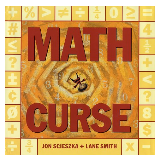
I love books that link math and literature, and one of my favorites is Math Curse by Jon Scieszka. Published in 1995 through Viking Press, the book tells the story of a student who is cursed by the way mathematics works in everyday life. It is a tale where everything is a math problem, from tabulating teeth to calculating a bowl of corn flakes. Everything in life becomes a math problem.

First you see the math teacher, Mrs. Fibonacci, (don’t you love that name?) declare, “You know, you can think of almost everything as a math problem.” Then you watch as the student turns into a “raving math lunatic” since s/he believes “Mrs. Fibonacci has obviously put a math curse on me.”

From sunrise to sunset, the student anxiously mulls over the answers to countless calculations such as: How much time does it take to get ready and be at the bus stop? (a problem the reader can solve.). Estimate how many M M's you would eat if you had to measure the Mississippi River using M Ms. There is even an English word problem: “If mail + box = mailbox, does lipstick – stick = lip? Does tunafish + tunafish = fournafish?” (silly, but funny.) A class treat of cupcakes becomes a study in fractions, while a trip to the store turns into a problem of money. The story continues until the student is finally free of the math curse, but then again Mr. Newton, the science teacher, regrettably says, “You know, you can think of almost everything as a science experiment.”

Math Curse is full of honest to goodness math problems (and some rather unrelated bonus questions, such as "What does this inkblot look like?"). Readers can try to solve the problems and check their answers located on the back cover of the book. The problems are perfect to get students’ minds working and thinking about how math really does apply to their everyday life.

The illustrations by Lane Smith are one of a kind. They are busy and chaotic to reflect the “math zombie” this student becomes. Many resemble a cut and paste project, with some images touching or overlapping others. Mostly dark colors are used especially when the student begins to dream s/he is trapped in a blackboard room covered with never-ending math problems. (a nightmare for many) Smith’s art work makes Scieszka's words come to life and helps to paint a picture of what is going through the mind of the main character as s/he deals with the dreaded math curse.

John Scieszka does a remarkable job of breaking down the typical school day into math problems while also adding some tongue-in-cheek and light hearted humor which every mathphobic needs. The math is perhaps a little advanced for elementary students, but the problems are perfect for middle school or high school students.

Math Curse also demonstrates how a problem may seem difficult, but if you are persistent, you can find the solution to the problem. The book teaches not to fear or be anxious about math or for that matter, any other subject in school. Despite the fact the main character is completely overwhelmed by mathematics, it allows students who struggle with the identical feeling to know they are not alone. Any student who has ever been distressed over numbers, fractions, word problems and the like will certainly identify with the main character.

As a math teacher, I think this book makes math fun as well as interesting. Although I recognize math is everywhere in everyday life, I never realized just how much until I read the Math Curse and mathematically saw the day of a typical student. I believe what sets Math Curse apart from other books is that it accurately illustrates and explains how math is actually used and applied in day-to-day life. I love the story, the message, and especially the content.